

Names, identity, age and appearance: see a person, not an inventory
Create a memorable fictional character: names, age, appearance, clothing and mannerisms, and a description that shows personality instead of listing features.
A list helps you. It rarely helps the reader.
When new writers set out to describe a fictional character, most start with a list: name, age, height, hair, eyes, shoes. That list can help you hold a picture in your head. But readers usually meet a character through what they do, and through what the viewpoint character happens to notice. Not every visible feature needs to reach the page. The right detail can carry several things at once: who someone is, their mood, their work, where they stand socially, and the trouble they’re in.
Four questions before any description
- How does this person see and name themselves?
- What does their appearance suggest before they say a word?
- What would a stranger assume about them?
- How might that assumption be wrong?
A name can carry a family tradition, a chosen identity or a place, but don’t hand one personality to everyone from a given background. Physical features earn their place when they affect action, communication, or how other people respond. Otherwise they’re optional, and it’s fine to leave them undecided until a scene needs them.
Compare two introductions
Flat. Sarah was thirty-four, medium height, and wore jeans and a blue jacket.
In motion. Sarah had changed into a clean jacket for the bank meeting. It already smelled faintly of transmission fluid. She rubbed at a grease stain on the cuff and went inside anyway.
The second version never mentions her height or her eyes. It tells us about her work, her self-consciousness, and the pressure of the meeting, and that’s enough to keep reading.
Choose two or three details that can come back
Someone speaks softly until challenged. Turns a ring while thinking. Wears work boots to a funeral. Hides a limp. Details like these can return later and mean more each time. Don’t turn every trait into a symbol or a clue, though: people are inconsistent, and a useful detail can be completely ordinary.
Common pitfalls
- Opening with a head-to-toe description before the character does anything.
- Deciding facts the story never needs, like eye colour, and then having to keep them consistent.
- Using appearance as a shortcut for personality or background.
- Choosing details so unusual they distract from the scene.
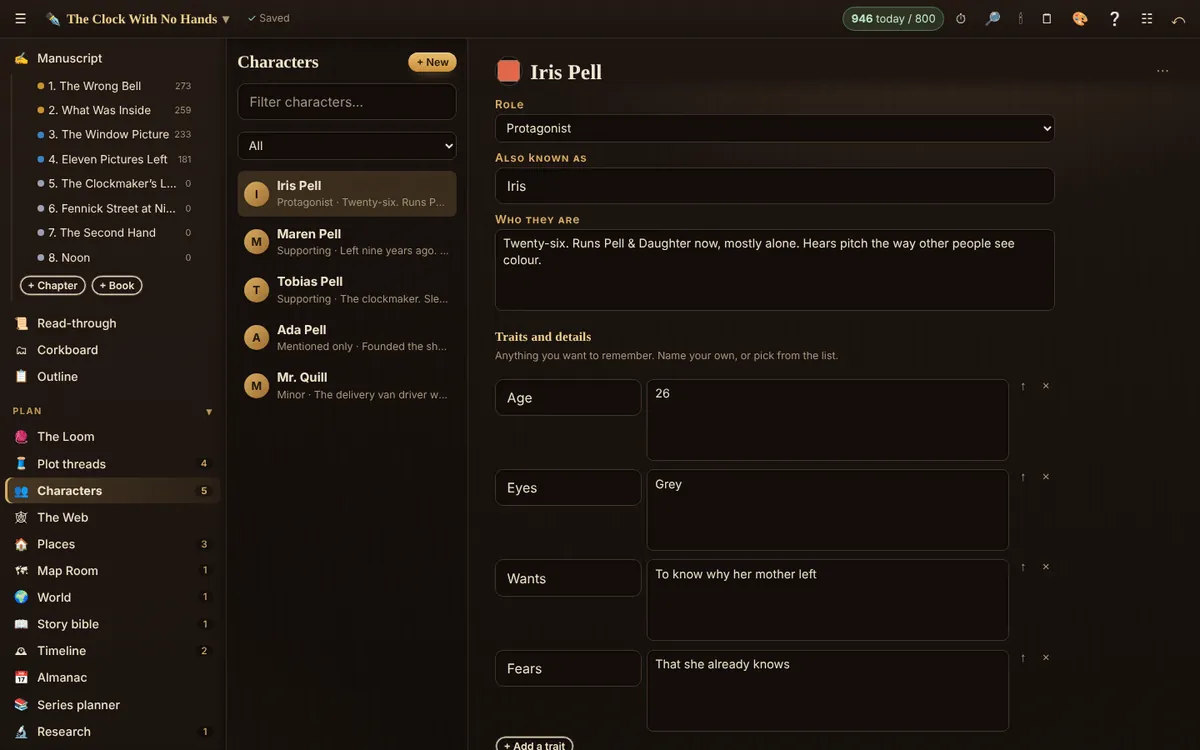
Your turn
Make your character, then introduce them doing something ordinary. Leave anything undecided blank: the card only records what you choose.
AI assistance on for this lesson
Character lessons start with Author Beta’s own AI switched on, to ask questions and suggest possibilities about your character. Switch it off any time with the Off button. Questions and hints send only your question (we add the lesson). A review sends only the answers you copy into the box. Nothing from your Writing Desk or your books is ever sent, and every request shows you exactly what will leave, and to which AI service, before you send it. Don’t include anything private or confidential. Feedback is advice and may be wrong; it never changes your progress, and every lesson can be finished without AI.
Sign in to use AI assistance.
Try this first
A common slip (The information dump): “Sarah Bennett was 34. She had brown hair, green eyes and was 5’6”. She was a mechanic. She was stubborn but kind.” Every fact is stated and none is shown. Nothing happens, so nothing is revealed. (And notice: this version decides her eye colour, which the story never needed.)
Still stuck?
Check your work
These are prompts, not rules. Done when: A character card saved or updated in one of your Writing Desk projects.
Stuck on a name? The Name Studio suggests names from 32 real traditions, with meanings, and saves straight to your Desk.
Related: Family, siblings, upbringing and backstory: make the past matter now · Characterisation through action, voice and scene: meet a person in motion · All of Character Academy
Sources and further reading
- Start writing fiction: 1.1 Creating characters, The Open University, OpenLearn. Checked Nov 19, 2026. A free university course section on building a main character first and letting conflict produce the plot.
- Start writing fiction: characters and stories (free course), The Open University, OpenLearn (updated 2019). Checked Nov 19, 2026. Free course on creating characters, keeping a writer’s notebook, and drafting and editing your own fiction.
This lesson and its examples are original to Author Academy. Sources are cited for ideas and further reading; nothing is copied from them, and no institution endorses this course. Version 1.