

Friends, rivals, partners and family trees: a relationship is a story, not a label
Create meaningful character relationships, family trees, rivalries, friendships and changing alliances, saved as a live relationship map of your story.
Helps to have: A main character; lessons 2 and 5 help.
The story lives in the expectations
“Friend”, “sister”, “boss” and “ex” are useful categories. The story is in what lies underneath: expectations, obligations, trust, unresolved conflict, and what each person knows about the other. Two people can both call themselves friends and disagree completely about what friendship requires. Kinship can stay fixed while closeness changes over the years.
Start with three people
Put your main character in the middle. Add one person who supports their goal, one who opposes it, and one whose interests are mixed. Then look at the gap between what each wants from the relationship and what the other is willing to give.
Example. Helen pushes Sarah to get legal advice. Michael offers help but expects her to reconsider the garage’s future. Victor works for the developer and may not realise what Sarah stands to lose. None of them needs to be purely good or evil. Each becomes useful because they can choose something Sarah can’t control.
Track how relationships change
Say Sarah rejects Michael’s offer at the start, accepts information from him in the middle, and trusts him with a crucial decision near the end. That’s three states of one relationship. A good map shows the current state and the events that changed it.
One link, seen from both sides
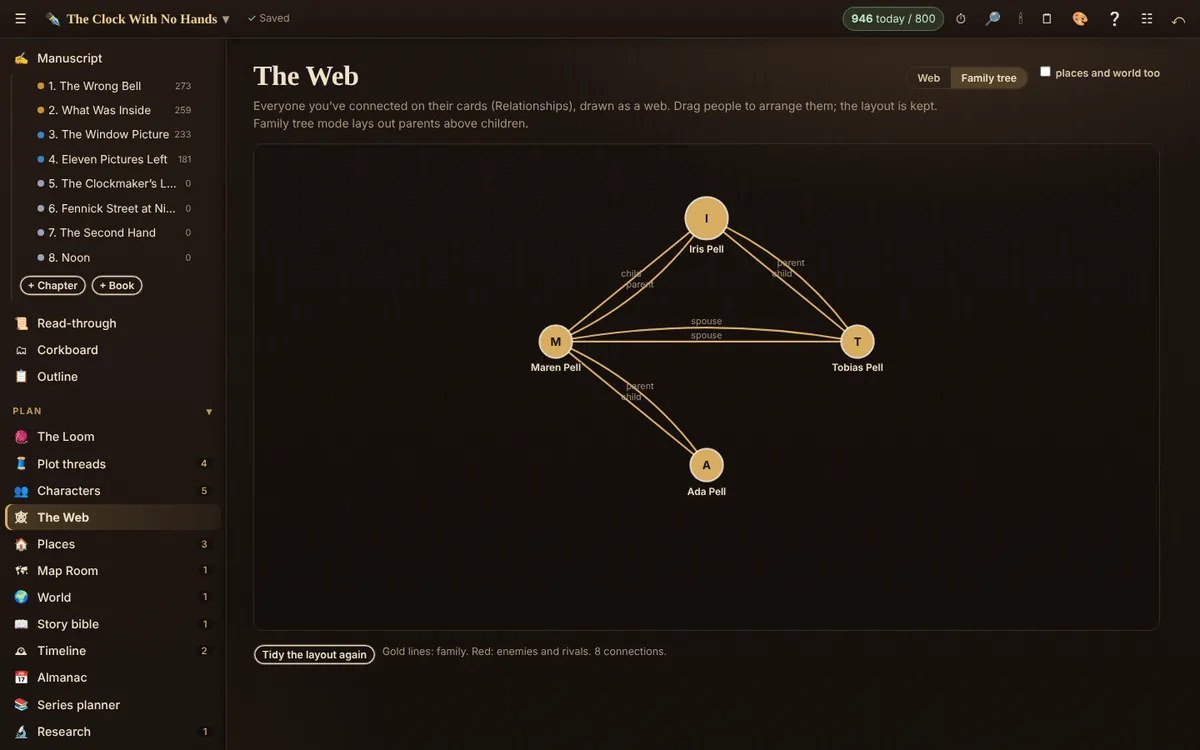
In your Desk, a link is made once. Put “sibling: Michael” on Sarah’s card and Michael’s card shows “sibling of Sarah” automatically. Kinship and closeness are separate: a brother can be estranged, and a friend can be family.
Common pitfalls
- Supporting characters who exist only to help or block the hero.
- Relationships that stay exactly the same from start to finish.
- Mixing up kinship and closeness: not every sibling is close.
- Duplicating people across notes instead of linking one card.
Your turn
Link three people to your character: someone for them, someone against them, and someone in between.
AI assistance on for this lesson
Character lessons start with Author Beta’s own AI switched on, to ask questions and suggest possibilities about your character. Switch it off any time with the Off button. Questions and hints send only your question (we add the lesson). A review sends only the answers you copy into the box. Nothing from your Writing Desk or your books is ever sent, and every request shows you exactly what will leave, and to which AI service, before you send it. Don’t include anything private or confidential. Feedback is advice and may be wrong; it never changes your progress, and every lesson can be finished without AI.
Sign in to use AI assistance.
Try this first
A common slip (Labels without tension): “Helen is Sarah’s best friend. Michael is her brother. Victor is the villain.” Nobody wants anything from anyone, so nothing can change. Give each relationship an expectation and a source of tension.
Still stuck?
Check your work
These are prompts, not rules. Done when: Linked character cards saved in one of your Writing Desk projects.
Open The Web in your Desk after saving: your new links are already drawn. Switch to Family tree for kinship.
Related: Family, siblings, upbringing and backstory: make the past matter now · Character arcs and emotional change: change is shown through decisions · All of Character Academy
Sources and further reading
- Start writing fiction: 1.1 Creating characters, The Open University, OpenLearn. Checked Nov 19, 2026. A free university course section on building a main character first and letting conflict produce the plot.
- Character Development: How to Write Characters Who Feel Real, Hugh Davies, Reedsy (October 12, 2026). Checked Nov 19, 2026. A practical article on what characters want and need, their weaknesses, and how they change.
This lesson and its examples are original to Author Academy. Sources are cited for ideas and further reading; nothing is copied from them, and no institution endorses this course. Version 1.