

Write and finish your first scene
How to write your first fiction scene and finish it: a goal, an obstacle and a turning point, with a worked example and an exercise you save to your book.
Helps to have: A main character and a place for them (earlier lessons in this school).
A finished scene beats an endlessly polished opening
Many new writers start with enthusiasm, rework the first paragraph again and again, and never reach the end of the scene. Revising matters, but drafting and revising are different jobs. In a first draft, give yourself permission to write something imperfect and complete.
1. Choose whose experience it is
Pick a viewpoint character. What do they know, notice, fear and misunderstand in this moment? You don’t need to explain their whole life. Keep the reader oriented by showing where the character is and what has their attention.
2. Give them a practical objective
Even in a quiet scene, your character needs a reason to act. They might want to get into a building, get an apology, find something out, or be left in peace. Make it specific enough that the reader can tell what success and failure look like.
Example. Sarah wants to get inside her garage. That’s more immediate than the larger goal of “saving her father’s legacy”, and the larger goal gives the small action its meaning.
3. Bring in resistance
A locked door. Someone who won’t help. An overheard remark that shows the dispute is more personal than Sarah thought. The obstacle can come from another person, the place, a lack of information, or the character’s own habits.
4. Make something change
A scene doesn’t need a dramatic reversal, but by the last paragraph something should be different. The character learns something, loses an option, changes plan, damages a relationship or commits to something.
Example. Sarah can’t get in. But instead of walking away, she decides to challenge the lockout. The next scene now has a direction.
5. Stop editing while you draft
Write the scene all the way to its changed situation. Mark anything you don’t know with a note like [check how a lockout works] instead of spending the session researching a small detail. Once the scene exists, revise for clarity, dialogue, rhythm and continuity.
See it in action: a quiet scene with a turn
Sarah waited outside the locksmith’s until the owner turned the sign to OPEN.
“You changed a lock on Bennett Garage yesterday,” she said.
The locksmith looked at the coffee in his hand. “I was hired to.”
“By who?”
“Company called Ridgeview Holdings.”
Sarah had expected that name. She hadn’t expected the folded envelope he took from under the counter.
“They told me not to give you this,” he said. “Your dad left it here before he died.”
Sarah reached for it, but the locksmith kept his hand flat on the envelope.
“He said to make sure your brother was with you when you opened it.”
She hadn’t spoken to her brother in eight months.
What changed? The scene began as a simple attempt to find out about a lock. It ends by tying the property dispute to family history, and leaves Sarah with a hard next decision.
Many writing teachers describe a scene as a goal, an obstacle and an outcome; Dwight V. Swain’s “goal, conflict, disaster” is one well-known version. Treat it as scaffolding, not a law: a quiet, reflective scene can work without an obvious confrontation.
Common pitfalls
- Polishing the first paragraph for days and never reaching the end.
- A scene where nothing changes between the first line and the last.
- Stopping to research a small detail instead of marking it and writing on.
- Explaining the character’s whole life before the action starts.
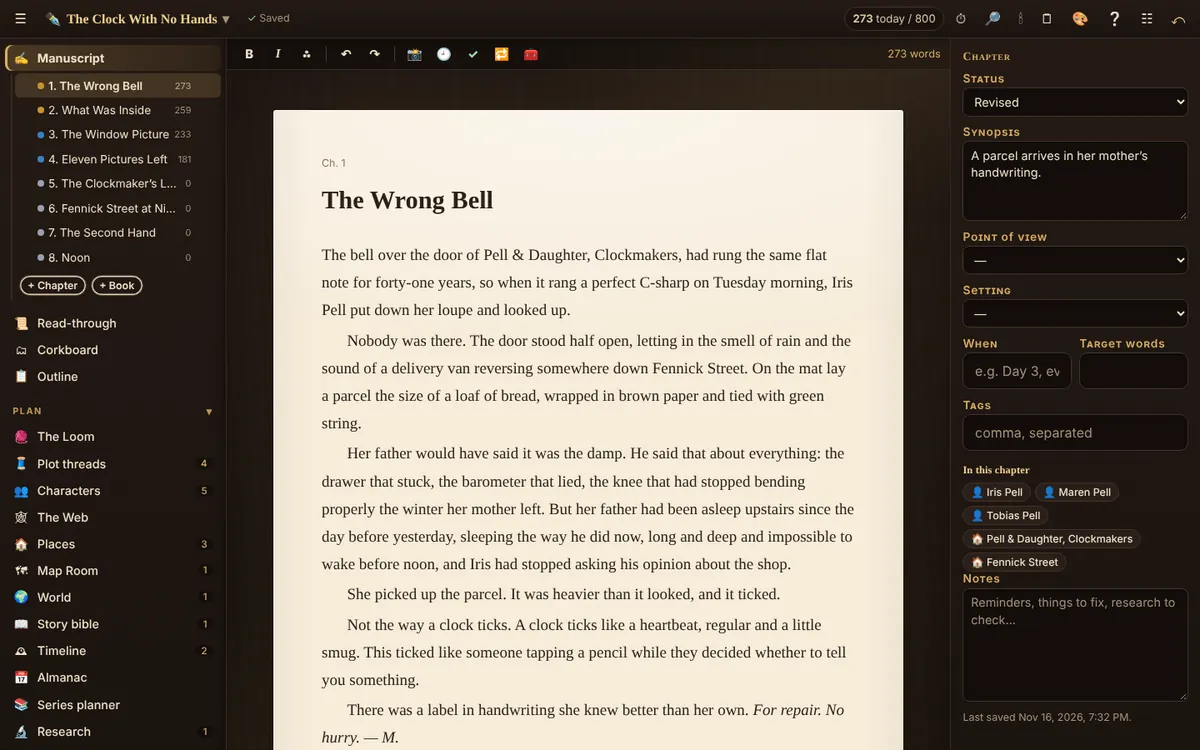
Your turn
Plan the scene in a few words, then write a first draft of about 400 to 700 words. It doesn’t need to be polished.
AI assistance optional, off
Off unless you switch it on. Ask about the lesson, get a hint, or have your exercise reviewed against this lesson’s checklist. It never writes the exercise for you. Questions and hints send only your question (we add the lesson). A review sends only the answers you copy into the box. Nothing from your Writing Desk or your books is ever sent, and every request shows you exactly what will leave, and to which AI service, before you send it. Don’t include anything private or confidential. Feedback is advice and may be wrong; it never changes your progress, and every lesson can be finished without AI.
Sign in to use AI assistance.
Check your work
These are prompts, not rules. Done when: A scene saved in a chapter of one of your Writing Desk projects.
The free Writing Desk holds one book with one chapter of up to six scenes, with every tool. Cliff Hanger or the Writing Desk plan unlocks the whole book.
Related: Plan the beginning, middle, and end of your story · All of First Words Academy
Sources and further reading
- Start writing fiction: characters and stories (free course), The Open University, OpenLearn (updated 2019). Checked Nov 19, 2026. A free university course on creating characters, keeping a writer’s notebook, and drafting then editing your own fiction.
- Techniques of the Selling Writer, Dwight V. Swain, University of Oklahoma Press (1965). Checked Nov 19, 2026. Source of the “goal, conflict, disaster” description of a scene; the link is a summary of the book’s scene-and-sequel idea.
This lesson and its examples are original to Author Academy. Sources are cited for ideas and further reading; nothing is copied from them, and no institution endorses this course. Version 1.