

Writing is creative; publishing is also a small business. Author income tracking tells you which books earn, which marketing pays back, and where money is leaking. These tools keep the numbers simple and help you avoid the expensive mistakes authors are often targeted with.
Regnskabsbog
What it does for you. What each book earned and cost, imported from store reports or typed in, with net and break-even per book.
How to use it. Add income from store reports (import or type) and add costs such as editing, covers and ads. The ledger shows net and break-even for each book. See ledger.
Why we built it. Store dashboards show sales but rarely show profit. Author income tracking needs costs and income side by side, per book.
Markedsføringsberegnere
What it does for you. Break-even cost per click, series value, promotion payback, events, crowdfunding and bookshop returns.
How to use it. Choose a calculator, enter your numbers, and see whether a plan can pay for itself. See measuring results.
Why we built it. Most ad losses come from not knowing the break-even point. A few minutes of maths before spending prevents that.
Example: series value
If book one leads some readers to buy books two and three, each new reader is worth more than one sale. Knowing that number tells you how much you can sensibly spend to find a new reader.
Eksperimentlog
What it does for you. Write the guess, budget and loss limit before you try something; record what happened after.
How to use it. Before an ad, promotion or price change, add an experiment with your expectation and limit. Afterwards, record the result. See experiments.
Why we built it. Without a record, it's easy to repeat what didn't work, or forget what did.
Tjek af tilbud og svindel
What it does for you. Paste an offer of promotion, reviews or a "deal" and see which documented scam patterns it matches.
How to use it. Copy the offer into the checker and read the matches and explanations. See marketing scams.
Why we built it. Authors are frequent targets of predatory services. A quick check before replying can save a lot of money. Writer Beware is an excellent independent source on scams aimed at writers.
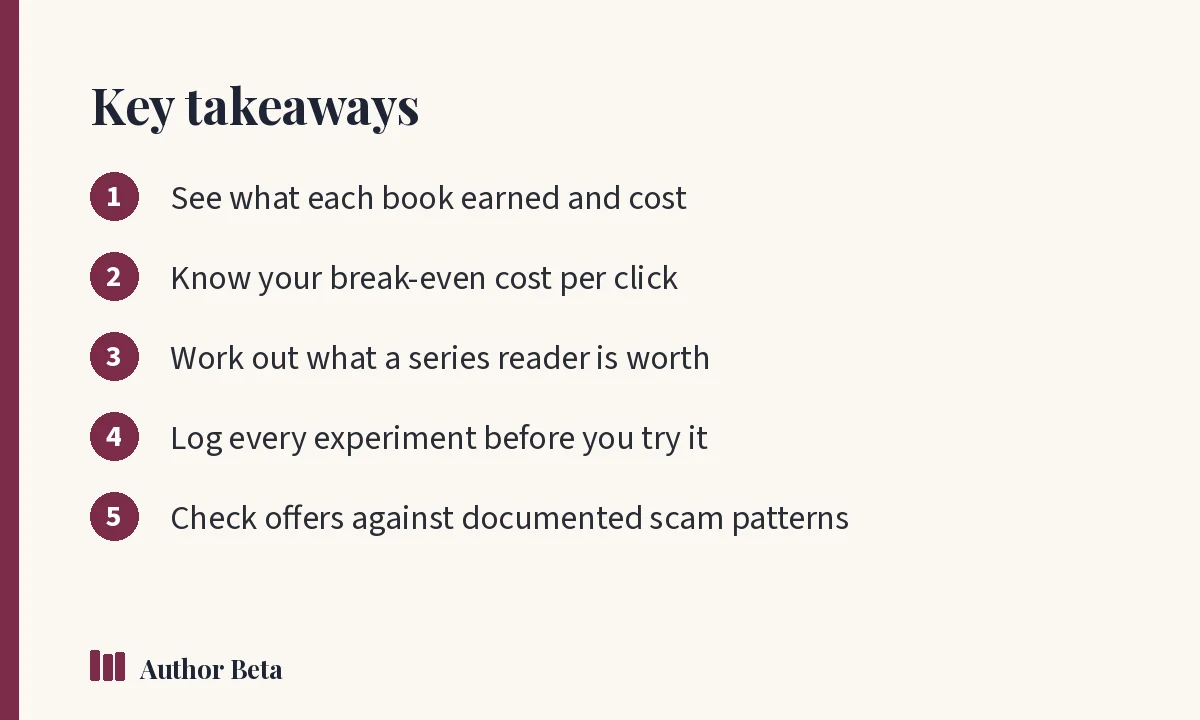
Author income tracking: a simple routine
- Once a month, import or enter store reports
- Add every cost: editing, covers, ads, tools
- Check net per book in the ledger
- Review experiments and decide what to repeat
- Run unusual offers through the scam checker
Taxes and records
Keep records of income and expenses for your tax filings. Rules vary by country, so check with an accountant or your tax authority. In the US, the IRS self-employed tax centre explains the basics. We're not tax advisers.
For the strategy side, read book marketing for indie authors.
What to track besides income
Income is only half the picture. For each book, it's also worth tracking:
- Read-through: what share of book one readers go on to book two
- Cost per new reader: what you spend on ads or promotions for each new reader you gain
- Newsletter growth: sign-ups per month, and where they came from
- Launch results: sales in the first weeks compared with your last release
These numbers explain the income figures. A book with modest sales but strong read-through may be your best investment for ads, because every new reader is worth several sales. The series value calculator turns read-through into that number.
Avoiding common money mistakes
- Spending on ads before the book's cover, blurb and reviews are ready
- Paying for "guaranteed" sales, reviews or rankings
- Forgetting small recurring costs such as subscriptions and software
- Not setting a loss limit before an experiment
Ofte stillede spørgsmål
Is the money ledger free?
Yes, the ledger, marketing calculators, experiments log and scam checker are free.
Can I import store sales reports?
Yes, the ledger imports store reports or you can type figures in.
Does the scam checker guarantee an offer is safe?
No. It shows which documented scam patterns an offer matches. Use it as one check alongside your own research.
Kommentarer