

Book metadata is all the information that describes your book: title, author, ISBN, categories, keywords, description, price and more. Stores, libraries and search engines use it to decide where your book appears and who sees it. Good book metadata can be the difference between a book that's found and one that's invisible.
What counts as book metadata?
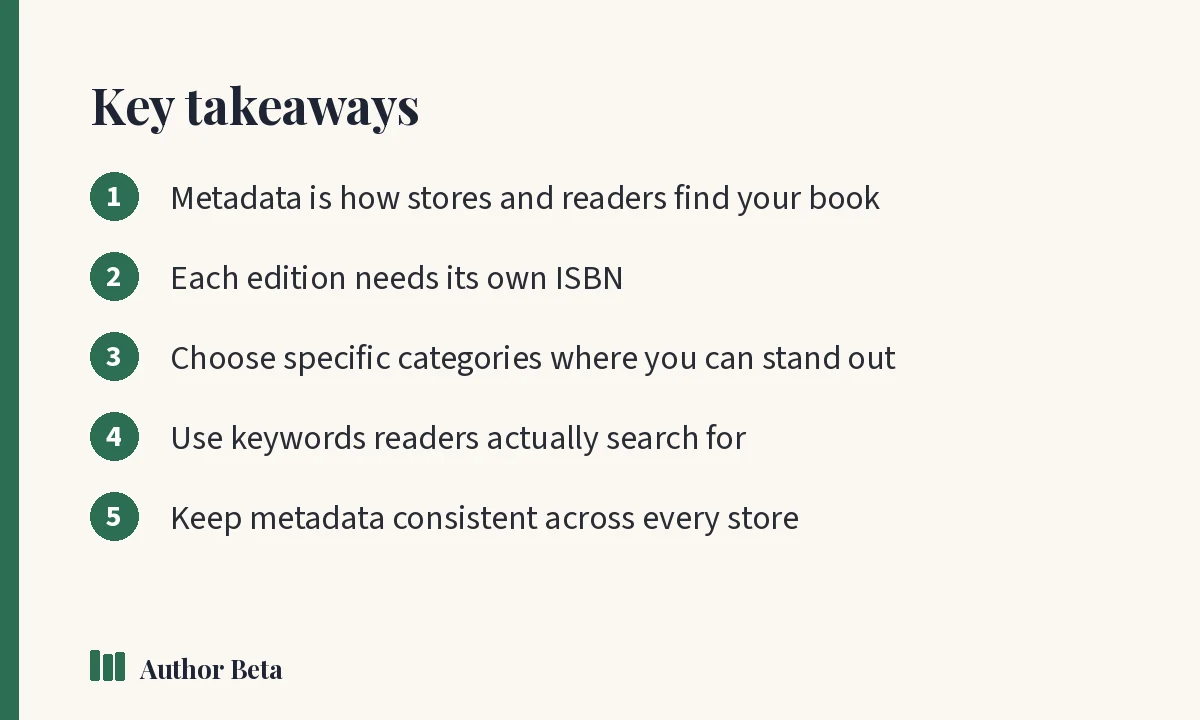
- Title, subtitle and series name and number
- Author and contributor names
- ISBN and format
- Publisher name and publication date
- Categories (BISAC and store categories)
- Søgeord
- Description (blurb)
- Price, territories and language
- Page count, trim size and age range
ISBNs: one per edition
An ISBN (International Standard Book Number) identifies a specific edition and format. Your paperback, hardcover and audiobook each need their own ISBN where one is required. Ebooks often don't require one on some stores, but having one can help with wide distribution and libraries.
Who sells ISBNs depends on your country. In the US, they come from Bowker; in the UK, from Nielsen. Some countries provide them free through national libraries.
Free ISBNs from print services usually list that service as the publisher. Buying your own lets you use your own publisher name.
Categories: be specific
Categories place your book on shelves, physical and digital.
- BISAC subject codes are the industry standard in North America, maintained by the Book Industry Study Group.
- Store categories are each store's own browse categories, which may differ from BISAC.
Choose the most specific categories that genuinely fit. Fiction › Mystery › Cozy › Culinary gives a better chance of being seen than Fiction › General. Check where bestselling comparable books are listed.
Keywords: think like a reader
Keywords help stores match your book to searches. Use words and phrases readers type, such as:
- Subgenre and tropes (enemies to lovers, locked room mystery)
- Setting (Scottish island, 1920s Paris)
- Character types (female detective, chosen one)
- Mood (heartwarming, dark academia)
Avoid using other authors' names, trademarked terms you don't own, or misleading terms. Store rules prohibit these. Amazon's KDP help pages list current rules for categories and keywords.
Series metadata
Enter series names and numbers exactly the same way for every book and format. Consistent series metadata lets stores link your books together, which helps readers find the next one.
Descriptions
Your description is metadata too, and the most persuasive part. See how to write a book blurb.
Keep book metadata consistent everywhere
Use the same title spelling, author name, series name and descriptions across every store, your book page and your press kit. Inconsistent metadata can split your book's listings or confuse readers.
On Author Beta, the Book Record holds every store detail for one book, typed once: description, keywords, categories, ISBNs, trim and prices. It checks them against store rules and works out your royalty per sale.
When to update book metadata
Metadata isn't set-and-forget. Review it when:
- Sales slow down
- You publish the next book in a series
- Category trends change in your genre
- You get a strong review quote to add
Book metadata for audiobooks and print
Each format needs its own metadata:
- Print: trim size, page count, paper type and print price affect how the book is listed and what it costs to produce.
- Ebook: file format, and whether the book is enrolled in any store programmes.
- Audiobook: narrator, running time and its own ISBN where required.
Keep the title, author name, series and description identical across formats so stores can link them on one book page. Inconsistencies, even a missing subtitle, can split formats into separate listings.
Ofte stillede spørgsmål
Does an ebook need an ISBN?
It depends on the store. Some don't require one for ebooks. Check each store's rules, and consider your own ISBN if you plan wide or library distribution.
How many categories can I choose?
It varies by store. Check each store's current limits and choose the most specific categories that genuinely fit your book.
Can I change categories and keywords after publishing?
Yes, most stores let you update them. Changes may take some time to appear.
Kommentarer