


A daily writing habit is the quiet engine behind most finished books. Motivation comes and goes; habits keep going. The good news is that you don't need hours a day. You need a small, reliable session that happens even when life is busy.
Here's how to build a writing habit that lasts beyond the first enthusiastic week.
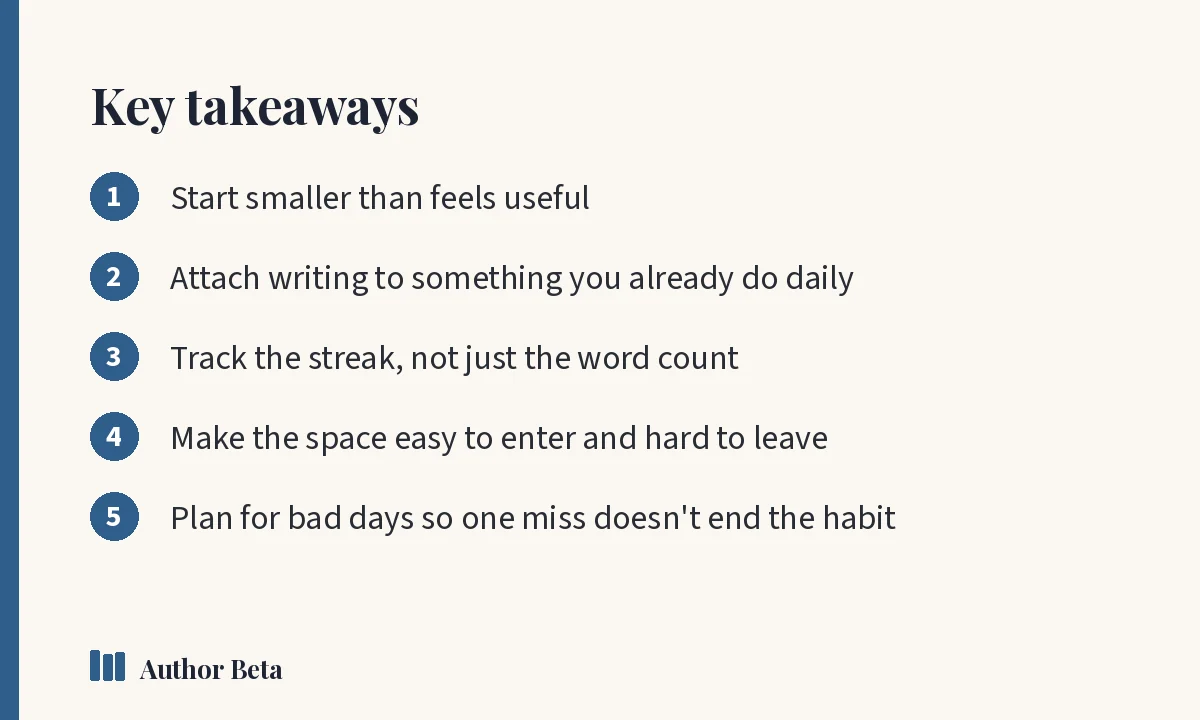
Start your daily writing habit smaller than feels useful
The most common mistake is setting a goal that only works on good days, like 2,000 words or two hours. Start with something you could do while tired: ten minutes, or 150 words. Small goals remove the resistance to starting, and once you start, you'll often write more.
After two or three weeks of consistency, raise the target slowly.
Attach writing to an existing routine
Habits stick when they're linked to something you already do every day. Try:
- After the first coffee, write for 15 minutes
- On the train home, draft one scene on your phone
- Before checking email at lunch, write 200 words
The anchor does the remembering for you.
Make the streak visible
Tracking turns an abstract intention into something you can see. A calendar with crosses, a word-count log, or a progress bar all work. Many writers find that a visible streak becomes its own motivation: you won't want to break it.
On Author Beta, the Writing Desk shows word counts and daily goals as you write, and its writing rooms include timed sprints for focused sessions.
Design a space that pulls you in
Make starting effortless and distractions hard:
- Keep your manuscript one click away
- Turn off notifications during the session
- Use the same place, music or lighting each time as a cue
- Leave yourself a note on what comes next before you stop
That last tip matters. Ending mid-scene, with a note like Next: Jo finds the second letter, means tomorrow's session starts with momentum instead of a blank page.
Plan for bad days
Every habit meets sick days, travel and family emergencies. Decide in advance what counts as a "minimum day": perhaps five minutes or a single paragraph. On those days, do the minimum and stop. Keeping the chain alive matters more than the word count.
If you miss a day, the rule is simple: never miss two in a row.
Separate drafting from editing
Daily sessions go faster when you don't edit as you write. Draft forward, leave notes for later, and save revision for a dedicated phase. Our guide on how to revise a novel covers that phase step by step.
Find accountability that suits you
Some writers thrive with company: writing groups, sprint partners or online challenges. Others prefer a private log. Try a few approaches and keep what works. Even telling one friend your goal can help.
Measure progress in finished pages
Word counts are useful, but finished scenes and chapters are what turn into a book. Every Friday, look back at what the week produced. Over a few months, a modest daily writing habit becomes a full draft, which is how most novels actually get written. For the bigger picture, see how to write a novel.
What the research on habits suggests
Habit research consistently points to the same practical ideas: make the behaviour easy, link it to a cue, and repeat it until it becomes automatic. How long that takes varies a lot from person to person, so don't be discouraged if writing still feels like effort after a few weeks. Keep the session small and the cue consistent, and it becomes easier over time.
Habits for different lives
- Parents of young children: write during nap time or before the house wakes; keep sessions short and protect them.
- Shift workers: anchor the habit to the start or end of a shift rather than a clock time.
- Full-time professionals: use commutes, lunch breaks or a fixed slot before work.
- Writers with chronic illness or fatigue: use the smallest possible minimum and count notes, outlines and dictation as writing.
The best routine is the one that fits your actual week, not an ideal one. For general guidance on building routines, the Purdue Online Writing Lab has free material on managing the writing process.
Domande frequenti
How long should a daily writing session be?
Long enough to make progress, short enough to protect on busy days. Many writers start with 15 to 30 minutes. Consistency matters more than length.
What if I don't feel inspired?
Write anyway, using a small target. Inspiration often arrives after you start. On truly empty days, outline the next scene or edit a page instead.
Is it better to write in the morning or at night?
Whichever time you can protect most reliably. Some writers prefer mornings before the day's demands; others write late when the house is quiet.



Commenti