

Series are one of the most reliable ways for authors to build a readership: readers who love book one often go on to buy the rest. But a series needs more planning than a standalone. Knowing how to plan a book series up front saves you from plot holes, contradictions and a finale that doesn't satisfy.
This guide walks through the decisions to make before and while you write book one.
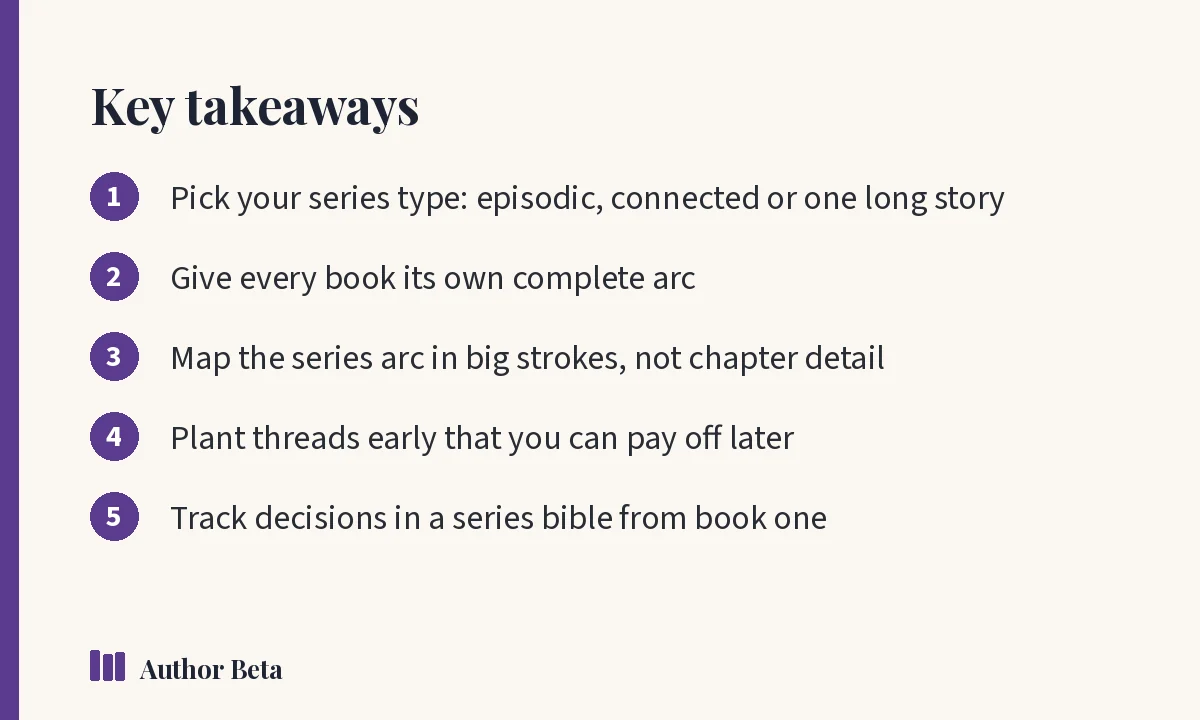
Choose your series type
There are three common shapes, and readers expect different things from each:
- Episodic series: each book stands alone with a new case or adventure; the main cast and setting recur. Common in mystery, cozy and many romance series. Readers can start anywhere.
- Connected series: each book has its own story, but characters develop and a bigger arc runs across books. Most fantasy, thriller and romantic suspense series work this way.
- One continuous story: a single narrative split across several volumes, such as an epic fantasy trilogy. Readers must start at book one.
Decide which one you're writing, because it changes how each book should end and how you market the series.
How to plan a book series arc
Plan the big arc in broad strokes, not chapter detail:
- Where does the series begin and end? Know the final state of your main character and world, even if the route changes.
- What escalates? Stakes should grow across books, whether personal, local or world-ending.
- What are the major turning points? Usually one big shift per book.
- What's the central question of the whole series? For example: Will the exiled heir reclaim the throne, and will it be worth the cost?
You can lay series-level and book-level beats side by side with the Writing Desk's series planner, which keeps every book of a series in one project.
Give every book its own complete arc
Even in a connected series, each book needs a satisfying shape: a problem introduced, escalated and resolved. Readers forgive an open series question; they rarely forgive a book that simply stops. A good rule is to resolve the book's main plot and leave the series question open.
Plant threads early
The most satisfying series pay off things planted books earlier: a minor character who becomes crucial, an object that returns, a prophecy that turns out to mean something else. Plant more threads than you'll use. Unused ones become texture; used ones feel inevitable.
Keep a list of planted threads and where each appears. The Writing Desk's Loom shows every thread against every chapter, which works across a series too.
Leave room to grow
Rigid plans break. Leave space for characters to surprise you, for reader favourites to get more page time, and for a series to extend if it sells well. Avoid early statements that lock you in, such as giving an exact number of years until the prophecy, unless you're sure.
Keep a series bible from book one
A series bible records every decision: names, ages, eye colours, place names, rules of magic, timelines and who knows which secret. Start it while writing book one, not when you're halfway through book three. See our full guide to creating a series bible.
Decide how many books, roughly
Trilogies are popular, but many series run longer or are open-ended. Consider:
- How big is the central question? Can it carry three books, or seven?
- How fast can you write? Long gaps between books lose readers.
- What does your genre expect?
If you're unsure, plan an arc that could end at book three and extend if readers want more.
Plan the release schedule early
How and when you publish matters as much as what you write. Some authors write several books before releasing any, so they can release quickly. Our guide to rapid release compares the options. For industry-wide guidance on self-publishing a series, the Alliance of Independent Authors offers free resources.
Questions fréquentes
Should I write the whole series before publishing book one?
Not necessarily, but drafting at least two books before publishing gives you room to fix continuity and plant threads. Many authors find it lowers the pressure of later deadlines.
How do I end each book in a series?
Resolve the book's main plot and leave the series question open. A small hook into the next book helps, but avoid cliffhangers that leave the main story unfinished unless your genre expects it.
Can I turn a standalone into a series later?
Yes, especially with episodic series. Revisit the first book and plant a few threads or recurring characters that future books can build on.
Commentaires