

Knowing how to revise a novel is what turns a first draft into a book people want to finish. Revision isn't polishing sentences; it's re-seeing the story. The trick is to work in passes, from the biggest problems down to the smallest, so you never perfect a paragraph you later cut.
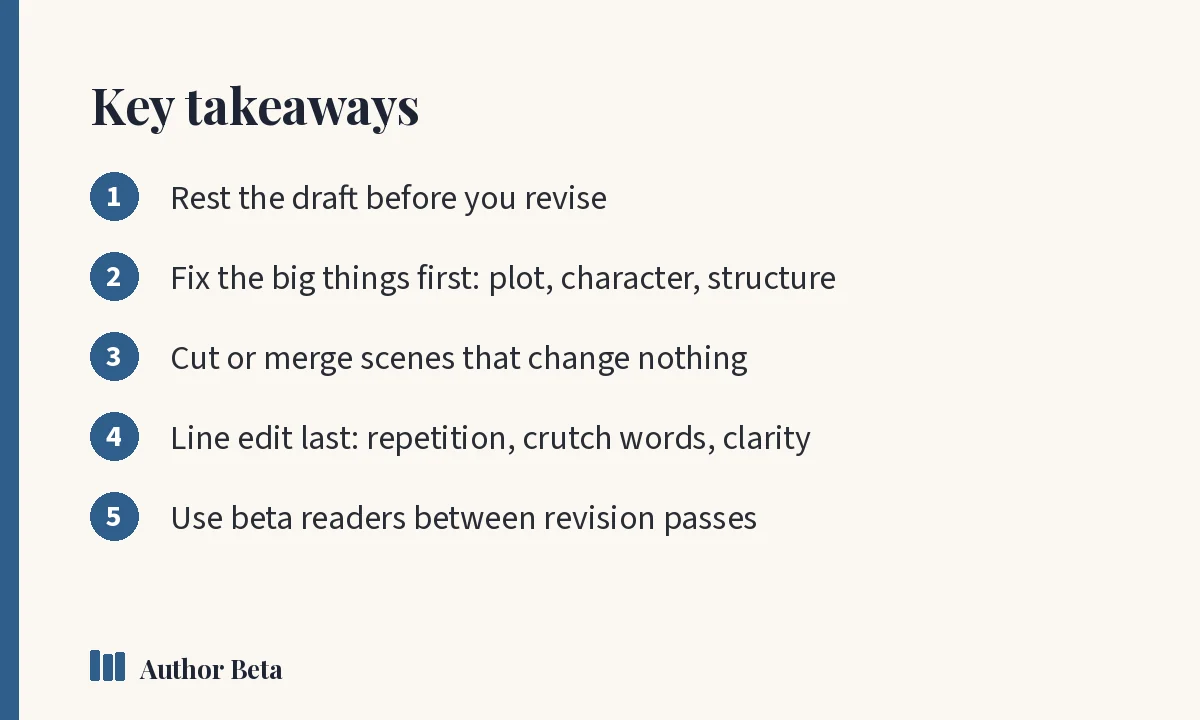
Before you start: rest the draft
Put the finished draft away for at least two weeks. Distance lets you read it more like a reader. Use the break to read in your genre or plan the next book.
When you come back, read the whole manuscript quickly, making only notes. Don't fix anything yet. You're looking for the shape of the problems.
How to revise a novel, pass 1: the story
Ask the big questions first:
- Is the central conflict clear by the end of the first act?
- Does the main character want something specific, and does it cost them?
- Does each act raise the stakes?
- Is the ending earned by what came before?
- Are there plot threads you started and forgot?
Dropped threads are among the most common first-draft problems. On Author Beta, the Writing Desk's Loom plot grid lays every thread against every chapter, so a subplot that vanishes in chapter six is visible at a glance.
Pass 2: Characters
- Does the protagonist change by the end?
- Do their choices, not coincidences, drive the plot?
- Does each secondary character have their own want?
- Could two minor characters be merged into one?
Check consistency too: eye colours, ages, names and relationships. A series bible or character cards make this far easier.
Pass 3: Scenes and structure
Make a scene list with one line per scene: what happens and what changes. Then:
- Cut scenes where nothing changes.
- Merge scenes that do the same job.
- Reorder scenes that would build tension better elsewhere.
- Add scenes only where the story genuinely skips a step.
Check the pacing of your opening. Many first drafts begin too early; the real story often starts a chapter or two later.
Pass 4: Line editing
Only now work at the sentence level:
- Repeated words and phrases
- Crutch words such as just, really, very, suddenly, started to
- Filter words such as she saw, he heard, she felt
- Unclear pronouns and long sentences that tangle
- Dialogue tags and adverbs (see how to write dialogue)
Search tools save hours here. The Writing Desk's Red Pencil checks the whole book for names spelled two ways, repeated phrases and crutch words, and the grammar check runs on your own computer so your words aren't sent anywhere.
Pass 5: Proofreading
Last comes a typo hunt. Change the font or read on a different device to see the text fresh. Reading aloud catches missing words that your brain fills in automatically.
Where beta readers fit
Beta readers are most useful after Pass 3, when the story is solid but before you spend weeks on sentences. They tell you where they were confused, bored or hooked, which guides the next round of revision. Read our guide to using beta reader feedback to turn their notes into a revision plan.
Your self-editing checklist
- [ ] Draft rested for at least two weeks
- [ ] Central conflict clear by the end of act one
- [ ] Every plot thread resolved or deliberately left open
- [ ] Protagonist changes; choices drive the plot
- [ ] Every scene changes something
- [ ] Opening starts where the story starts
- [ ] Repetition, crutch words and filter words reduced
- [ ] Names, ages and details consistent
- [ ] Final read aloud for typos
How to revise a novel without losing momentum
Revision can feel endless. A few habits keep it moving:
- Keep a revision list. Before each pass, write down exactly what you're looking for. Tick items off as you go.
- Work on copies. Save each draft separately so you can always go back. The Writing Desk keeps snapshots for this reason.
- Set a deadline for each pass. Open-ended revision tends to drift into rewriting.
- Know when to stop. When your changes start making the book different rather than better, it's time for readers or an editor.
Getting a professional edit
After self-editing and beta readers, many authors hire an editor. A developmental editor looks at structure and story, a line editor at style, and a copyeditor or proofreader at correctness. The Alliance of Independent Authors publishes free guidance on choosing editors and other publishing services.
Perguntas frequentes
How many drafts does a novel need?
There's no set number. Many authors do three to five revision passes. Working in focused passes, rather than rewriting from scratch each time, usually gets you there faster.
Should I hire an editor or self-edit first?
Self-edit first. The cleaner your manuscript, the more value you get from an editor, and the less you'll pay for fixes you could have made yourself.
How long does revising a novel take?
Often as long as drafting it, sometimes longer. A few months of revision for a full-length novel is common and worth it.
Comentários