

Knowing how to write dialogue well is one of the fastest ways to make a manuscript feel professional. Good dialogue sounds like real people talking, but it isn't a transcript. It's real speech with the dull parts removed and every line doing a job.
Learning how to write dialogue is a skill you can practise. Here are nine practical tips you can apply to your next scene, plus the most common dialogue mistakes to fix during revision.
How to write dialogue: make every line earn its place
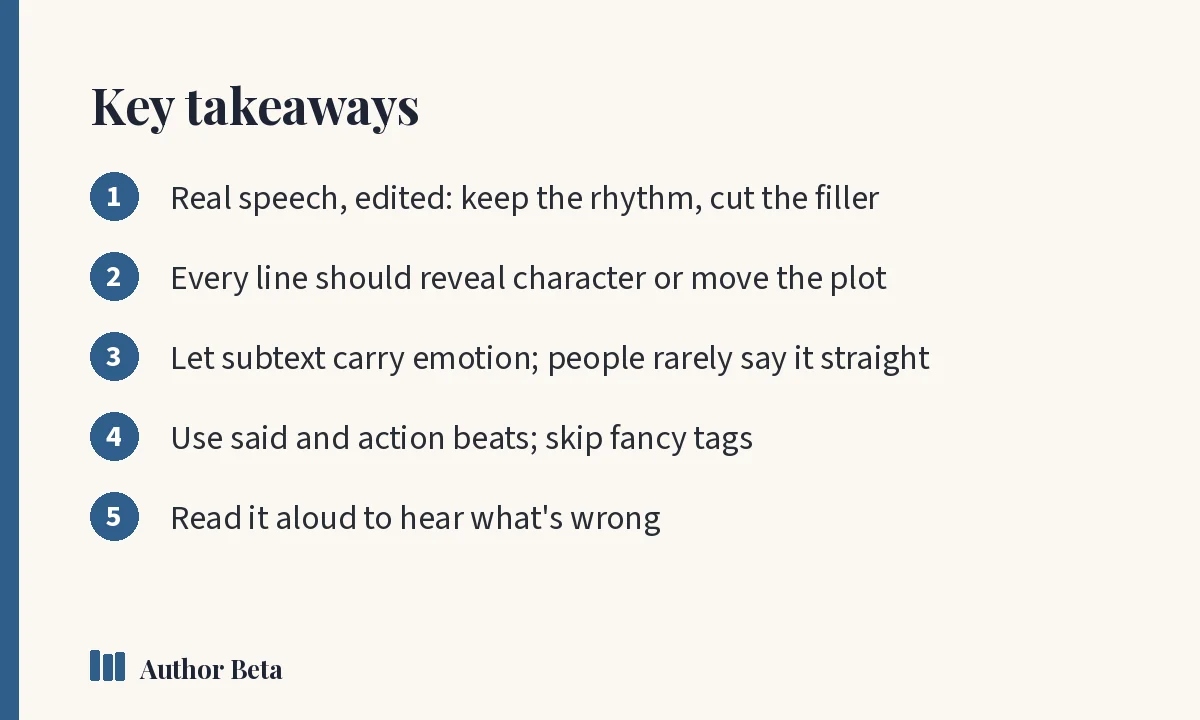
Each exchange should do at least one of these: reveal character, raise tension, or move the plot. Small talk like greetings and weather usually goes. If a line only passes information both characters already know, cut it or find a reason one of them doesn't know it.
2. Give each character a distinct voice
Readers should be able to guess who's speaking without a tag. Voice comes from vocabulary, sentence length, rhythm and what a character notices. A nervous teenager, a retired judge and a ship's engineer don't sound the same.
A quick test: cover the names and read the conversation. If you can't tell the speakers apart, adjust word choice and rhythm for one of them.
3. Let subtext do the heavy lifting
People rarely say exactly what they mean, especially about feelings. Subtext is the gap between what's said and what's meant.
"You're home early."
"Meeting finished early."
"It always does on Fridays."
Nobody mentions suspicion, yet it's all over the page.
4. Use "said" and action beats
"Said" is almost invisible to readers, which is exactly what you want. Fancy tags like expostulated or hissed (for a line with no s-sounds) pull attention away from the words.
Even better, use action beats to show who's speaking and what they're doing: Jen pushed the plate away. "I'm not hungry."
5. Punctuate dialogue correctly
Correct punctuation keeps readers in the story:
- Comma inside the quotes before a tag: "I'll go," she said.
- New paragraph for each new speaker
- Action beats are separate sentences: "I'll go." She grabbed her coat.
For detailed rules, the Chicago Manual of Style is the standard reference for fiction in US English.
6. Avoid the "as you know, Bob" problem
When characters explain things to each other that they both know, purely to inform the reader, dialogue sounds false. Find a character who genuinely doesn't know, or reveal the information through conflict instead.
7. Keep speeches short
Long monologues stall pace. Break them with interruptions, reactions or action. In tense scenes, short lines and quick back-and-forth create speed.
8. Write dialect and accents lightly
A few distinctive words and some rhythm suggest an accent better than phonetic spelling, which is tiring to read and can become a caricature. Less is more.
9. Read it aloud
Your ear catches what your eye misses: tongue-twisters, unnatural phrasing and lines that are too long to say in one breath. If you stumble while reading, a reader will stumble too.
Common dialogue mistakes to fix in revision
- Characters using each other's names in every line
- Every character sounding like the author
- Adverbs on tags doing the emotional work (she said angrily)
- Greetings, goodbyes and small talk that go nowhere
- Info-dumps disguised as conversation
The Writing Desk's Red Pencil flags repeated phrases across a whole book, which often catches a character's overused catchphrase. Beta readers are invaluable here too: ask them which characters they could tell apart by voice alone.
For a related craft skill, see show, don't tell, which explains how dialogue can reveal emotion without stating it.
How to format dialogue in a manuscript
Clean formatting helps editors, agents and beta readers focus on the words:
- Start a new paragraph each time the speaker changes.
- Keep a speaker's action and speech in the same paragraph.
- Use double quotation marks in US English and single in much of UK publishing; be consistent.
- For a speech that runs across several paragraphs, leave off the closing quotation mark at the end of each paragraph except the last, and open each new paragraph with a quotation mark.
- Use an em dash for interrupted speech and an ellipsis for trailing off.
Practise with real conversations
Listen to how people actually talk in cafés, on buses and in queues. Notice how often they interrupt, change the subject, answer a question with a question, or avoid saying what they mean. You don't want to copy real speech word for word, but noticing its patterns trains your ear. Then compare it with dialogue in novels you admire and see what the author kept and what they cut.
Ofte stilte spørsmål
How do I know if my dialogue sounds natural?
Read it aloud, ideally to someone else. Natural dialogue is easy to say, varies in rhythm, and leaves some things unsaid. If it sounds like a speech or a textbook, trim it.
How much dialogue should a novel have?
There's no fixed ratio. Thrillers and romance often use a lot; literary fiction may use less. What matters is that dialogue scenes and narrative scenes alternate so the pace varies.
Should I use dialogue tags at all?
Yes, when needed for clarity, especially in conversations with three or more people. Use "said" and "asked" most of the time, and replace some tags with action beats.


Kommentarer