

Point of view in fiction decides whose eyes the reader sees through, and it shapes everything from tension to voice. Choosing the wrong POV can make a good story feel distant or confusing. Choosing the right one can make readers feel they're living inside it.
This guide covers the main options, what each does well, and how to switch viewpoints without confusing your readers.
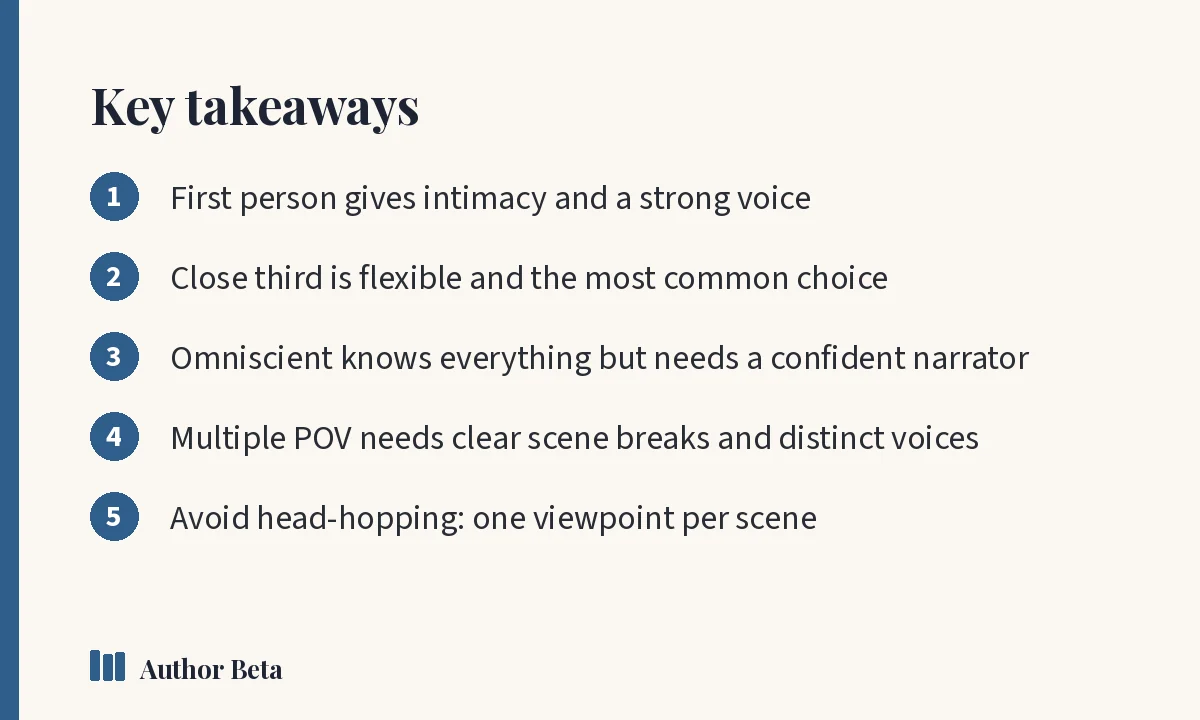
First person: intimate and voice-driven
I knew the door would be locked before I tried it.
First person tells the story through "I". It gives immediate intimacy and a strong, personal voice, which is why it's popular in young adult fiction, romance, crime and memoir-style novels.
Strengths: deep access to one character's thoughts, a distinctive voice, natural unreliable narration.
Watch for: the narrator can only know what they experience, every sentence must sound like them, and too much internal commentary can slow the pace.
Close third person: flexible and popular
She knew the door would be locked before she tried it.
Close (or limited) third person uses "he", "she" or "they" but stays tightly inside one character's perceptions per scene. It's the most common choice in commercial fiction because it combines intimacy with flexibility.
Strengths: easy to switch viewpoint characters between scenes, room for a slightly broader narrative voice.
Watch for: drifting into knowledge the character couldn't have.
Omniscient: the all-seeing narrator
An omniscient narrator knows everything: every character's thoughts, the past and the future. It's common in classic fiction and some epic fantasy.
Strengths: sweeping scope, irony, and the ability to tell readers things the characters don't know.
Watch for: emotional distance, and the need for a confident narrative voice so it reads as deliberate rather than accidental head-hopping.
Second person: rare but striking
You know the door will be locked before you try it.
Second person is unusual in novels but can be powerful in short fiction, interactive stories and some literary work. Use it when the form serves the story, not as a gimmick.
Multiple POV: several characters, one story
Many novels rotate between two or more viewpoint characters, often chapter by chapter. Romance frequently alternates between the two leads; thrillers may include the villain's view.
To make multiple POV work:
- Give each viewpoint character a distinct voice and goal
- Make each POV chapter advance the plot, not repeat events
- Signal the switch clearly with a chapter or scene break, and the character's name early in the first line
- Ask whether every viewpoint is necessary; fewer is often stronger
On Author Beta, the Writing Desk's Loom shows every plot thread against every chapter, which makes it easy to see when one viewpoint has been absent for too long.
Head-hopping and how to avoid it
Head-hopping happens when the narrative jumps between characters' thoughts within a single scene, leaving readers unsure whose experience they're in. The fix is simple: one viewpoint per scene. If you need another character's perspective, add a scene break.
How to choose point of view in fiction for your book
Ask yourself:
- Whose story is it? Who changes the most?
- Who has the most at stake in each key scene?
- Does the story need secrets the reader shouldn't learn yet? First person or close third keeps them hidden.
- What do recent bestsellers in your genre usually use?
If you're unsure, write the opening scene in two different POVs and see which feels alive. Beta readers can tell you which version pulled them in. See questions to ask beta readers for how to frame that test.
Tense and point of view work together
Point of view pairs with tense. Past tense is the most common choice in fiction and feels natural to most readers. Present tense, especially with first person, creates immediacy and is popular in young adult fiction and thrillers. Whichever you choose, keep it consistent within a viewpoint, because accidental tense shifts are among the most common first-draft errors.
Narrative distance
Within any point of view you can move closer or further away. A distant line describes from outside: The woman stood at the window. A close line sits inside the character's head: Where was he? Strong writers zoom in for emotional moments and pull back for transitions. If a scene feels flat, try moving the narrative distance closer.
For a clear academic overview of narrative perspective, the Purdue Online Writing Lab covers point of view and narration in its creative writing resources.
Perguntas frequentes
What is the most common point of view in fiction?
Close third person is the most common in commercial fiction, followed by first person. Both keep readers close to a character's thoughts while letting the story move quickly.
Can I mix first and third person in one novel?
Yes. Some novels use first person for the main character and third person for others, or switch for a prologue. Make the pattern consistent so readers know what to expect.
What is head-hopping?
Head-hopping is switching between characters' internal thoughts within the same scene. It can confuse readers and weaken tension. Use scene breaks when you change viewpoint.

Comentários