


Series continuity is what makes a multi-book story feel real. When details stay consistent, readers trust you and sink deeper into the world. When they don't, even small slips, a changed surname, a wrong sibling count, pull readers out and fill review sections with complaints.
Here's how to protect continuity across a series, whether you're writing book two or book ten.
Why series continuity breaks
Continuity errors usually come from three places:
- Memory: you wrote book one years ago and can't remember every detail.
- Revision: you changed something in a late draft and didn't update everything that depended on it.
- Scale: more books mean more characters, places and rules to track.
None of these are about carelessness. They're about the limits of memory, which is why systems help.
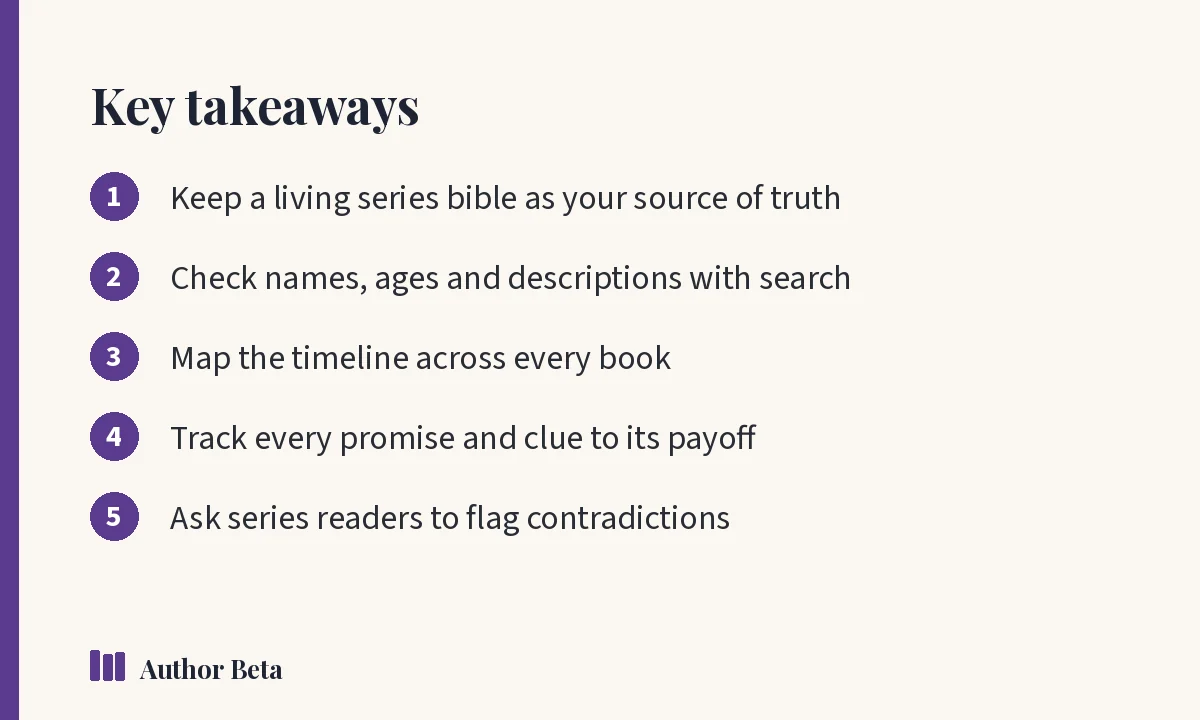
Keep a single source of truth
A series bible is the foundation. When a detail appears in a draft, it should also exist in the bible. When you change it, change it in both places. Treat the bible as the master record.
Run consistency searches
Before you send a book to readers or editors, search the manuscript for:
- Every character name and its variations (Katharine, Katherine, Kat)
- Place names and invented words
- Ages, dates and durations (three years ago)
- Eye and hair colours
- Repeated descriptions that may contradict
The Writing Desk's Red Pencil flags names spelled two ways across a whole book, which catches one of the most common series continuity errors automatically.
Map the timeline across books
Timeline errors are among the hardest to spot. Build a single timeline covering every book: dates, seasons, ages and how long journeys take. Check that:
- Characters age correctly between books
- Seasons and weather match the dates
- Travel times are consistent
- Events referenced as "last year" actually happened a year earlier
Track promises and payoffs
Every clue, prophecy, unanswered question and Chekhov's gun is a promise to readers. Keep a list with where each was planted and where it pays off. Before the final book, check that every major promise is either resolved or deliberately left open.
A plot grid like the Loom helps here by showing each thread against each chapter.
Respect the rules of your world
If magic costs blood in book one, it can't be free in book four without explanation. Note every rule, its limits and its exceptions. When you need to break a rule, make it a story event that characters notice.
Use readers who know the series
Series readers often remember details better than authors. Ask beta readers who have read earlier books to flag anything that contradicts what came before. Give them a specific question: Did anything here contradict the earlier books? See questions to ask beta readers for more.
Fixing continuity errors after publication
If readers find a continuity error in a published ebook, you can usually upload a corrected file. Print editions need a new upload too. Keep a list of corrections and fix them in one batch. The KDP help pages explain how to update published files on Amazon.
A pre-release series continuity checklist
- [ ] Series bible updated with every new detail from this book
- [ ] Name and spelling search complete
- [ ] Timeline checked against previous books
- [ ] World rules consistent or deliberately changed
- [ ] Promises and clues tracked
- [ ] Series readers asked to flag contradictions
Series continuity for co-written and long-running series
When more than one person writes in a world, or a series runs for many years, a shared series bible becomes essential. Agree on who updates it, how changes are recorded, and which source wins if two notes disagree. A single, current document is worth more than several partial ones.
Domande frequenti
How do authors keep track of details in a long series?
Most use a series bible, a timeline and search tools. Many also reread key chapters from earlier books before starting a new one.
Do readers really notice continuity errors?
Dedicated series readers often do, especially with names, ages, relationships and world rules. Small slips are forgiven; repeated ones affect trust.
Can I change something from an earlier book on purpose?
Yes. Retcons can work if they're handled openly within the story or corrected in updated editions. Avoid quiet changes that leave readers wondering if you forgot.

Commenti