

Receiving beta reader feedback can be thrilling and painful in the same afternoon. One reader loves the scene another wants cut. Someone suggests a whole new ending. Handled well, beta reader feedback is the fastest way to improve a manuscript. Handled badly, it can pull your book in ten directions.
Here's how to make sense of it all.
Step 1: Read everything, then wait
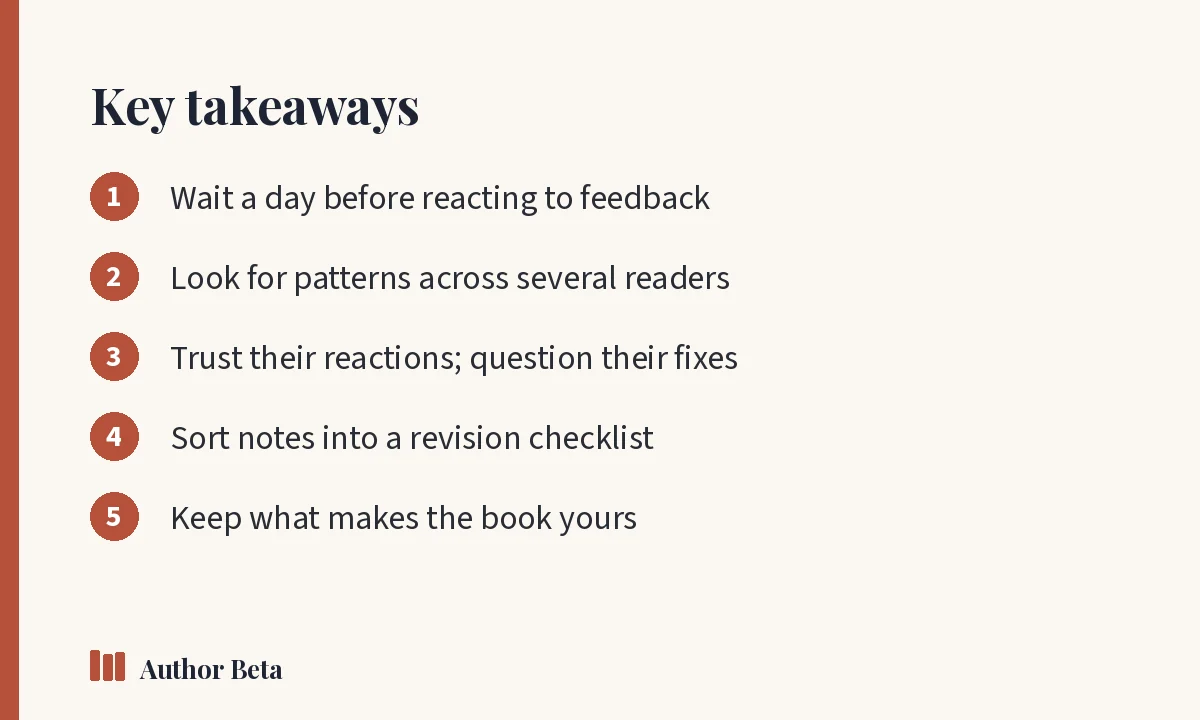
Read all the feedback once, without replying or changing anything. Then wait at least a day. First reactions to criticism are emotional; decisions should be calm. Thank every reader regardless of what they said.
Step 2: Look for patterns
A single comment is an opinion. The same comment from several readers is information. Group notes by topic:
- The opening
- Each main character
- Specific chapters or scenes
- The middle
- The ending
If five out of eight readers slowed down in chapter twelve, chapter twelve has a problem, even if they all describe it differently.
On Author Beta, every reader note is pinned to the exact chapter, paragraph and words, and the reading tracker shows where interest dropped across readers, so patterns are easy to see.
Step 3: Separate problems from solutions
Readers are excellent at noticing problems and less reliable at fixing them. When a reader says "Make the villain her brother," the real feedback may be "The villain's motive didn't feel personal enough."
For each piece of beta reader feedback, ask: what reaction caused this suggestion? Then solve that problem your own way.
Step 4: Decide what to act on
Sort notes into three groups:
- Act on: patterns, clear errors, confusion, and anything that matches your own doubts.
- Consider: single strong opinions that might improve the book.
- Let go: suggestions that would make it a different book, or that conflict with your genre or vision.
Your voice, themes and style are yours. Feedback should help you tell your story better, not turn it into someone else's.
Step 5: Make a revision checklist
Turn the "act on" group into a list of concrete tasks, ordered from biggest to smallest:
- Rework the motivation for the betrayal in chapter 18
- Cut or merge chapters 11 and 12
- Clarify the timeline in the flashback
- Fix name confusion between Tara and Tamsin
On Author Beta, the punch list lets you sort reader notes straight into a revision checklist and export your manuscript with notes in the Word margins.
Step 6: Revise, then test again
After revising, consider a second smaller round with a few new readers, or ask original readers to check specific changed chapters. Fresh readers show whether the fix worked. Our self-editing checklist helps you work through revisions in the right order.
Handling difficult beta reader feedback
- Harsh feedback: focus on the useful part, thank the reader, and move on. Not every reader is right for every book.
- Contradictory feedback: look at what's behind each reaction; often both readers are pointing to the same underlying issue.
- Feedback you disagree with: you're allowed to disagree. Keep a note in case it comes up again with other readers.
- Too little feedback: follow up with your two most important questions to ask beta readers.
Use beta feedback in your marketing
Once revised, the reactions readers loved, the chapters they highlighted and how many finished, can become marketing. On Author Beta, Reader Proof turns your beta read into quotable proof, with readers' permission.
For guidance on how reviews and endorsements may be used in marketing, see the US FTC's endorsement guides.
Preguntas frecuentes
Should I reply to every beta reader comment?
A thank-you is enough. Debating notes rarely helps; if you need clarification on something important, ask a short, neutral question.
What if one reader hates my book?
It happens to every author. Check whether their concerns match other readers. If not, they may simply not be your reader.
How many rounds of beta reading should I do?
One or two rounds is common: one on the full revised draft, and a smaller one after major changes.
Comentarios