

Writers often use the terms interchangeably, but beta readers, critique partners and editors do different jobs. Understanding beta readers vs critique partners vs editors helps you ask the right people for the right feedback at the right time, and avoid paying for help you could get earlier and free.
Critique partners
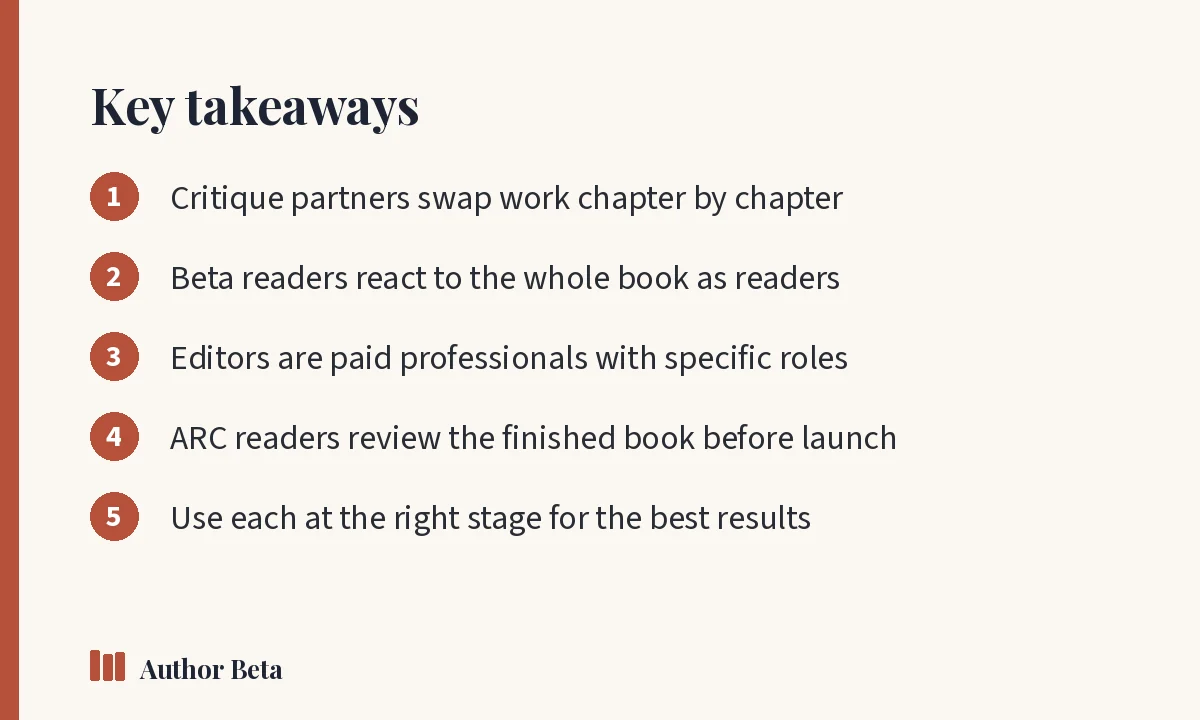
A critique partner is usually another writer who swaps work with you, often chapter by chapter, over a long period.
What they do: comment on craft, such as structure, character, pacing and prose, from a writer's perspective.
When: during drafting and early revision.
Cost: usually free, in exchange for reading their work.
Best for: catching craft problems early, staying motivated, and learning by critiquing others.
Beta readers
A beta reader reads the whole manuscript as a reader and reports their experience.
What they do: tell you where they were hooked, confused, bored or moved. They answer, "How does this book feel to read?"
When: after you've revised the big story issues, before line editing and professional editing.
Cost: often free, sometimes paid.
Best for: finding big-picture problems such as slow middles, unclear motivations and unsatisfying endings. See how to find beta readers.
Beta readers vs critique partners: the key difference
The core difference in beta readers vs critique partners is perspective. Critique partners read as writers and tell you why something isn't working and how to fix it. Beta readers read as readers and tell you that something isn't working, and where. Both are valuable. Many authors use critique partners during drafting and beta readers once the draft is complete.
Editors
Editors are paid professionals, and there are several kinds:
- Developmental editor: big-picture structure, plot, character and pacing
- Line editor: style, voice and sentence flow
- Copyeditor: grammar, consistency and correctness
- Proofreader: final typos and formatting errors
When: after beta readers, so the editor works on a stronger draft.
Cost: varies widely by type and length. Get quotes and samples. The Alliance of Independent Authors publishes guidance on choosing editors, and Writer Beware warns about scams aimed at authors.
ARC readers
ARC (advance review copy) readers receive the finished, edited book before launch and agree to post honest reviews around release.
When: a few weeks before publication.
Best for: early reviews and launch buzz, not for changing the book.
On Author Beta, review copies give each reader their own copy with a leak code inside.
Where each fits in your process
- Drafting: critique partners
- First revision: critique partners, self-editing
- Complete revised draft: beta readers
- After beta revisions: developmental or line editor
- Final manuscript: copyeditor, proofreader
- Before launch: ARC readers
Getting the most from each
- Tell everyone what stage the book is at and what feedback you need
- Ask specific questions (see questions to ask beta readers)
- Look for patterns across multiple readers
- Thank people and return the favour
On Author Beta, beta readers pin notes to the exact sentence, and you can sort them into a punch list that becomes your revision plan.
Questions to ask before choosing a critique partner
- Do they write in your genre, or at least read it widely?
- How often can they swap chapters, and how quickly?
- Do they give feedback you can act on, kindly and honestly?
- Do their goals match yours, for example traditional or self-publishing?
Try a short trial swap of one chapter each before committing to a full manuscript.
Questions to ask before choosing an editor
- Can they show samples or a short test edit?
- What exactly does their service include, and how many rounds?
- What's the timeline and total cost?
- Do they have experience in your genre?
Clear expectations up front prevent most disappointments with critique partners and editors alike.
Vanliga frågor
Can a beta reader also be a critique partner?
Yes, but it helps to be clear about which role they're playing for a particular manuscript. A writer can read as a beta reader if you ask for reader reactions rather than craft fixes.
Do I need an editor if I have beta readers?
Beta readers and editors do different jobs. Beta readers show you how the book feels; editors fix how it's written. Many self-published authors use both.
What's the difference between beta readers and ARC readers?
Beta readers read before the book is finished and help you improve it. ARC readers read the finished book and review it around launch.
Kommentarer