

Beta readers read your manuscript before it's published and tell you how it feels as a reader: where they were hooked, confused or bored. They're one of the most valuable resources an author has, and you don't need a big platform to find beta readers who help.
Here's where to look, how to choose, and how to keep good readers coming back.
What makes a good beta reader?
The ideal beta reader:
- Enjoys your genre and reads it regularly
- Finishes books, and tells you honestly where they nearly stopped
- Can describe their reaction ("I didn't believe she'd forgive him") rather than rewriting your prose
- Respects that your manuscript is unpublished and private
Fellow writers can be great beta readers, but readers who don't write often give the purest reader reaction.
9 places to find beta readers
1. Your existing readers and newsletter
If you have any published work or a newsletter, invite subscribers. They already like your writing. See our guide to building an author newsletter.
2. Genre reader communities
Online groups and forums for your genre often welcome beta reading requests. Read each community's rules first; many have a dedicated thread.
3. Writing groups and critique circles
Local and online writing groups often swap manuscripts. Be ready to read for others in return.
4. Friends of friends who read your genre
Close friends and family tend to be too kind. Friends of friends who love your genre are often more honest.
5. Social media
Post a short, clear request with your genre, word count, timeline and what you're looking for. Share a hook, not the whole blurb.
6. Libraries and bookshops
Some libraries and independent bookshops run reading groups whose members may be interested, especially for local settings or authors.
7. Book clubs
A book club reading together can give rich feedback through discussion. Offer to join the session.
8. Beta reading platforms
Platforms connect authors with readers who want to read early. On Author Beta, you can list your book in Open betas so readers who love your genre can request a spot, and your first beta read is free.
9. Readers of similar authors
Readers who review books like yours are often keen to discover new authors. Approach respectfully and never spam.
How many beta readers do you need?
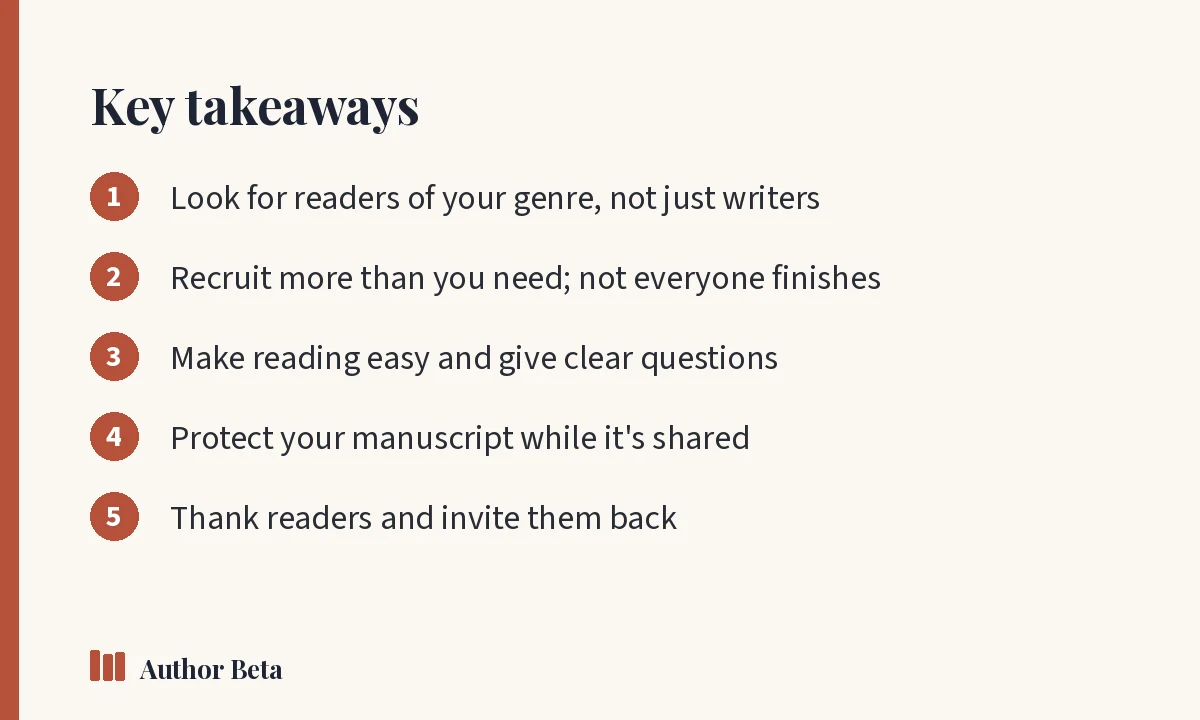
Many authors aim for five to fifteen. Recruit more than you need, because not everyone finishes. With several readers, patterns emerge: if one reader dislikes a scene, it's an opinion; if five do, it's a problem.
Make reading easy
Readers are doing you a favour, so remove friction:
- Let them read on any device without installing anything
- Give a clear deadline, usually two to six weeks
- Ask a few specific questions instead of "what did you think?" (see questions to ask beta readers)
- Send a friendly reminder halfway through
On Author Beta, readers read in their browser and pin notes to the exact sentence they're reacting to, and you can see how far each reader got. Reader check-ins let you email readers their own progress and deadline.
Protect your manuscript
For independent advice on safe ways to share work, see Writer Beware.
Sharing an unpublished book carries a small risk of leaks. Practical protections include sharing with people you trust, avoiding open download links and using a platform that keeps the text private. Author Beta encrypts your manuscript before it leaves your computer, and every page carries the reader's name plus hidden marks that trace copied text to its source.
How to keep good beta readers
- Thank each reader personally
- Tell them what you changed because of their notes
- Credit them in the acknowledgements, if they'd like
- Send them the finished book
- Invite your best readers to the next round first
Preguntas frecuentes
Should I pay beta readers?
Many beta readers volunteer, while others offer paid beta reading services. Paid readers can be useful but aren't required. If you pay, agree on the scope and timeline in advance.
When should I find beta readers?
After you've self-edited the big story issues but before line editing and professional editing. That's when big-picture reader reactions are most useful.
How do I find beta readers if I have no audience?
Start with genre communities, writing groups and beta reading platforms. Offering to read for others is one of the fastest ways to build connections. For more ideas, the Alliance of Independent Authors shares guidance on working with readers.
Comentarios