

Beta readers read books before they're published and help authors make them better. It's a chance to read stories nobody else has seen and to shape them. If you want to know how to be a beta reader that authors value and invite back, the secret is simpler than you might think: read honestly, and tell the author how the book felt.
What does a beta reader do?
A beta reader reads a manuscript that's finished but not yet final, and reports their experience as a reader. Authors want to know where you were hooked, confused, bored or moved. You don't need to be a writer, an editor or a literature expert. You need to enjoy the genre and be willing to share your reactions.
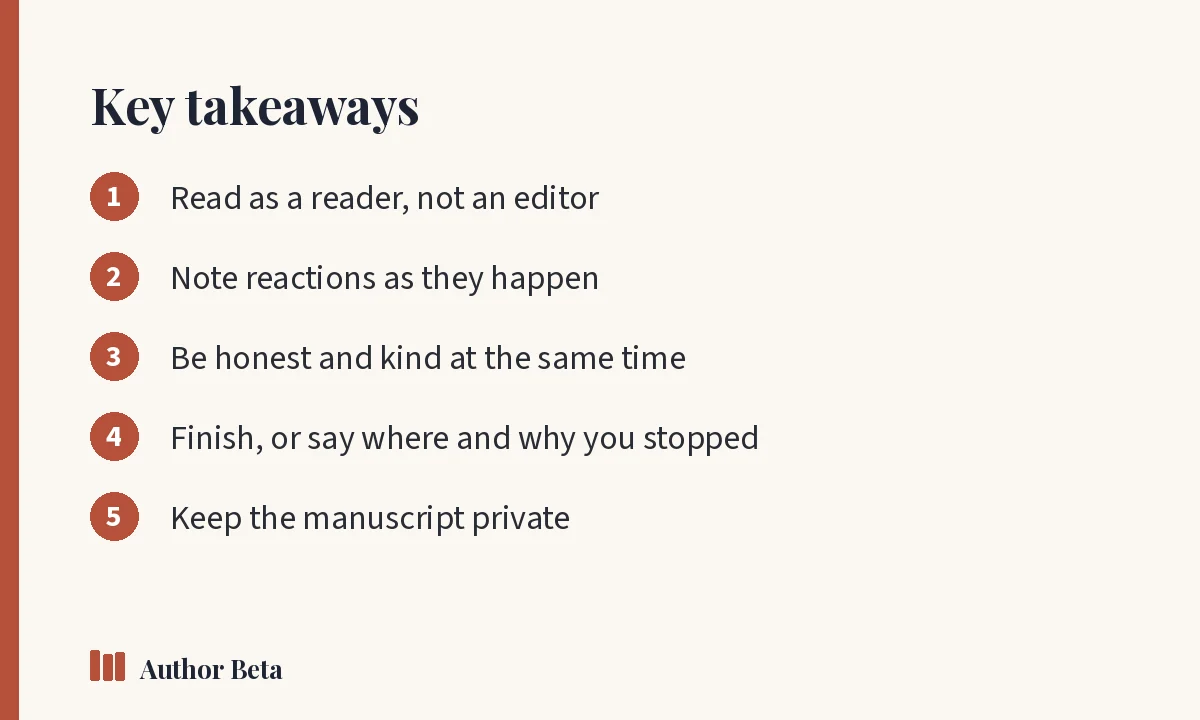
How to be a beta reader: read as a reader
Your most valuable perspective is that of an ordinary reader. Fixing commas is an editor's job. Instead, notice:
- Where you couldn't put the book down
- Where your attention drifted
- Moments you didn't believe
- Characters you loved, disliked or confused
- Anything you had to reread to understand
Note reactions as they happen
Reactions fade fast. Jot notes while reading rather than waiting until the end: "Laughed out loud here," "Lost track of who's speaking," "Skimmed this description."
On Author Beta, you read in your browser and pin notes to the exact sentence, so the author sees exactly what you were reacting to.
Be honest and kind
Authors ask for beta readers because they want the truth, but tone matters. A useful pattern:
- Be specific: "I got confused in chapter 7 when the timeline jumped" beats "the middle was confusing."
- Describe your reaction, not a fix: "I didn't believe she'd forgive him so quickly" is more useful than "rewrite the ending."
- Mention what works: knowing what to keep is as useful as knowing what to change.
- Remember it's a draft: the book will change because of your notes.
Answer the author's questions
Most authors share specific questions for beta readers. Answer them, even briefly. If you have extra thoughts, add them after.
Finish the book, or explain why you stopped
If you stop reading, that's important feedback. Tell the author where and why. "I stopped at chapter 14 because I lost interest in the subplot" can be one of the most valuable notes they get.
Respect deadlines and privacy
- Let the author know early if you can't finish on time
- Never share, copy or post the manuscript or plot details
- Don't post reviews of the beta version unless the author asks
Unpublished books are private work. On Author Beta, manuscripts are encrypted, and every page carries your name, so respecting privacy protects you as well as the author.
Where to find books to beta read
- Author newsletters and social media posts asking for readers
- Writing and reading communities
- Beta reading platforms: on Author Beta you can read free as a beta reader, browse Open betas and request a spot in genres you love
Is beta reading paid?
Most beta reading is voluntary. Some readers offer paid beta reading services with set turnaround times. Either way, agree on expectations before you start. If you post honest reviews of finished books you received free, check the disclosure rules in your country, such as the US FTC guidance on reviews.
Example notes that help authors
- "Chapter 3, the café scene: I laughed out loud at the scone line."
- "I got confused here about whether this is the same day or the next morning."
- "I guessed the twist at this point, because of the locked drawer."
- "I skimmed the next three pages of description; I wanted to get back to Mara."
- "I didn't believe he'd leave without saying goodbye; it felt out of character."
Each one tells the author where and what, without telling them how to fix it.
Frequently asked questions
Do I need experience to be a beta reader?
No. Authors want genuine reader reactions. Enjoying the genre and being willing to share honest, specific thoughts is enough.
How long does beta reading take?
Usually two to six weeks for a full novel, depending on length and the author's deadline. Let the author know early if you need more time.
What if I don't like the book?
Say so, kindly and specifically. Explaining why a book didn't work for you is valuable feedback, especially if you read the genre regularly.
Comments