

Your book blurb (also called the book description or back cover copy) has one job: make a browsing reader want to start reading. It's not a summary. Knowing how to write a book blurb is a sales skill, and it's one most authors find harder than writing the book itself.
Here's a simple formula, examples of each part, and the mistakes to avoid.
How to write a book blurb: the four-part formula
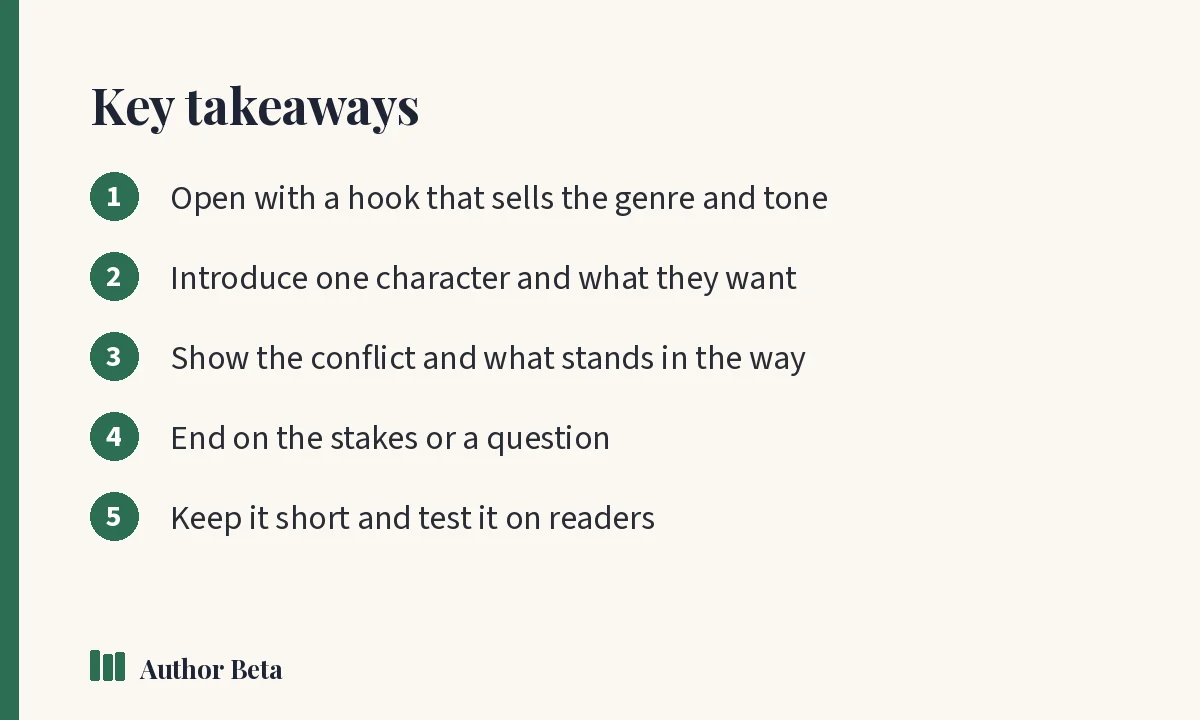
1. The hook
Open with one or two lines that grab attention and signal genre and tone. It can be a striking situation, a bold statement or a question.
Some secrets are buried for a reason. Others are buried alive.
2. The character and their goal
Introduce your main character, what they want and what makes them interesting. Usually one character is enough; two for romance.
Wren Calloway just wants to run her late aunt's bookshop in peace.
3. The conflict
What stands in the way? Introduce the problem or antagonist and how things escalate.
But when a stranger dies in the poetry section, the police suspect Wren, and the only person who believes her is the infuriating crime writer next door.
4. The stakes and a closing line
What happens if the character fails? End with tension, a question or a promise of the reading experience.
To clear her name, Wren must find a killer who knows every hiding place in the shop. And she's running out of time.
Write for the genre
Readers use blurbs to check that a book matches what they love:
- Romance: both leads, the obstacle between them, the emotional promise
- Mystery and thriller: the crime, the investigator, the danger
- Fantasy and science fiction: the world in a few words, the character, the threat
- Literary fiction: voice, theme and the central question
Read the blurbs of bestsellers in your category and notice patterns in length, tone and structure.
How long should a book blurb be?
Most fiction blurbs run between about 100 and 250 words. Store pages often show only the first few lines before "Read more," so the hook must work on its own.
Formatting tips
- Short paragraphs, often one to three sentences
- Bold or italic for the hook if the store allows
- Series name and number if relevant
- Optional: a short line of comparisons, such as For fans of cozy small-town mysteries
Mistakes to avoid
- Summarising the whole plot
- Too many character names
- Clichés like "a journey of self-discovery" without specifics
- Vague stakes ("everything will change")
- Starting with backstory instead of the story
Test your blurb
Show two or three versions to readers who love your genre and ask which they'd click. Beta readers are perfect for this, especially if you ask them to describe your book in one sentence (see questions to ask beta readers).
On Author Beta, the Pitch Kit builds your hook, comparable books, tropes, blurb, keywords and pitches step by step for each book, and Reader Proof can add lines beta readers loved.
Where your blurb goes
Your blurb will appear on store pages, your book page, the back cover, press kits and promotions. Keep a short version (one or two sentences) for social posts and a longer one for stores. For store rules on descriptions, see Amazon's KDP help pages.
A short blurb example
Some secrets are buried for a reason.
When a stranger dies in her bookshop, Wren Calloway becomes the police's favourite suspect. Her only ally is the crime writer next door, who's more interested in a plot than in her innocence.
To clear her name, Wren must find a killer who knows every hiding place in the shop, before the killer finds her.
This version is short enough for a store page, shows the genre and tone, introduces one main character, sets up the conflict and ends on the stakes.
Ofte stilte spørsmål
Should a blurb reveal the ending?
No. A blurb sells the setup and the stakes. Revealing the ending removes the reason to read.
Can I use review quotes in my blurb?
Yes, if you have permission and they're genuine. Short, specific quotes from recognisable sources work best. Never invent or misattribute reviews.
Should I write the blurb before or after the book?
Both. A draft blurb before writing clarifies your story's core; a final blurb after editing reflects the finished book.
Kommentarer