

Learning how to write a novel is less about talent and more about process. Most first novels stall not because the idea is weak, but because the writer has no clear next step after chapter three. This guide gives you that path, from a one-line premise to a revised draft that real readers can test.
You don't need an MFA, an agent or a perfect plan. You need a story you care about, a repeatable way to show up, and a method for turning a rough draft into a good one.
Step 1: Find a premise you can say in one sentence
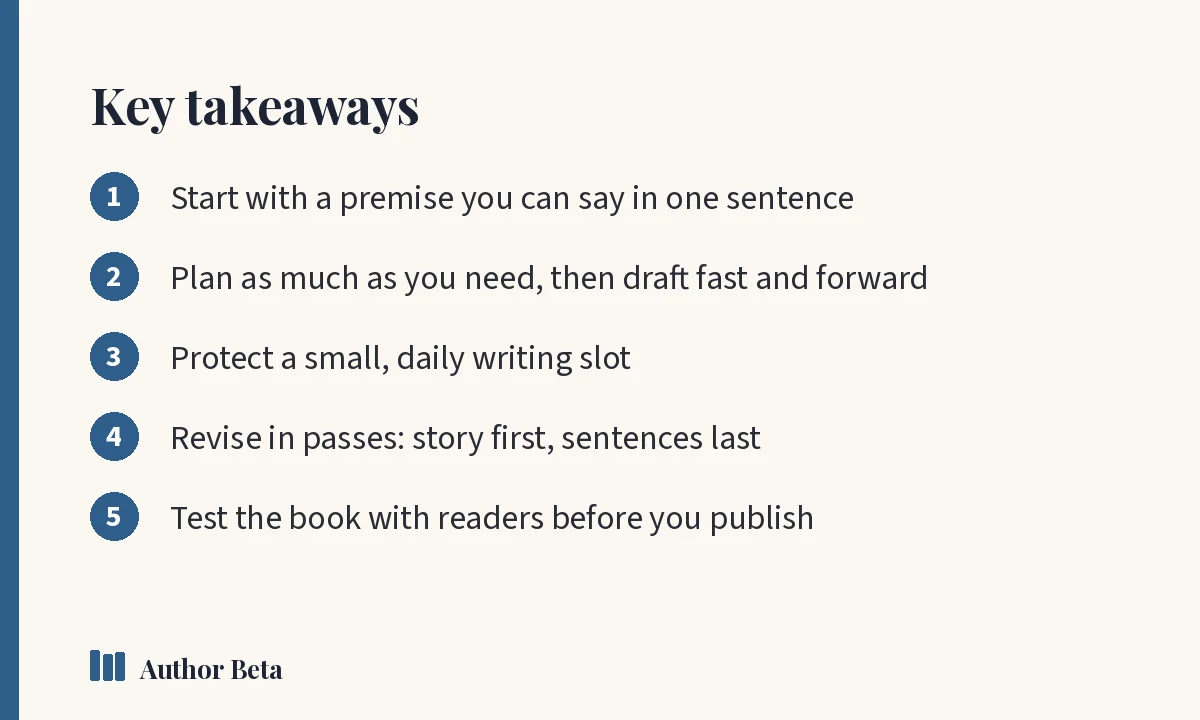
Before you write chapter one, try to describe the book in a single sentence: who wants what, what stands in the way, and what's at stake. For example: A retired lighthouse keeper must solve her neighbour's murder before the storm cuts the island off from the mainland.
If you can't say it in a sentence yet, that's useful information. It usually means the main character's goal or the central conflict isn't clear. Keep refining until the sentence makes you want to read the book yourself.
Step 2: Decide how much to plan your novel
Writers sit somewhere between plotters, who outline every chapter, and pantsers, who discover the story as they write. Neither is wrong. What matters is knowing enough to keep moving.
A light plan that works for most first novels:
- The opening situation and what disrupts it
- Three or four big turning points
- The climax, even if you change it later
- Who your main character is at the start and who they are at the end
If you like structure, lay a classic shape over your chapters, such as three acts or the beats of your genre. On Author Beta, the Writing Desk can show story structures beside your chapters so you can see which beat is missing.
Step 3: Know your characters' wants and wounds
Readers follow people, not plots. For each main character, write down what they want, what they're afraid of, and what they believe that isn't quite true. That false belief is often where your story's emotional arc lives.
Keep these notes somewhere you can see while drafting. A character card with a name, a want, a fear and a few physical details saves hours of searching later. Our character cards and relationship web are built for exactly this.
Step 4: Draft fast and forward
The first draft's only job is to exist. When you learn how to write a novel, the biggest trap is polishing chapter one for months. Write forward instead. If you change your mind about something, leave a note in brackets, such as [make her a pilot from the start], and keep going.
Practical drafting habits:
- Set a small daily target you can hit even on bad days, such as 300 words
- Stop mid-scene, so tomorrow starts easily
- Don't reread more than the last page before you write
- Track your word count; visible progress is motivating
Step 5: Build a writing routine you can keep
A sustainable routine beats occasional marathons. Pick a time and place, and protect it. Fifteen focused minutes every day adds up to a full draft faster than a whole weekend once a month. If you need help with this part, read our guide to building a daily writing habit.
Step 6: Rest, then revise in passes
When the draft is done, put it away for a couple of weeks. Then revise in layers, biggest problems first:
- Story: Does the plot hold together? Are there threads you dropped?
- Character: Does each main character change, and do their choices drive the plot?
- Scenes: Does every scene change something? Cut or merge the ones that don't.
- Sentences: Only now fix wording, repetition and typos.
Our self-editing checklist for revising a novel walks through each pass in detail.
Step 7: Test the book with beta readers
You can't see your own book clearly, because you know what you meant. Beta readers show you what's actually on the page: where they got confused, bored, or hooked. Choose readers who enjoy your genre, give them a few focused questions, and look for patterns rather than single opinions.
On Author Beta, your first beta read is free. Up to 20 readers read your book in their browser and pin notes to the exact sentence, and your manuscript is encrypted before it leaves your computer. See how to find beta readers for where to start.
Step 8: Decide what comes next
After a final revision you might query agents, self-publish, or keep the book as practice for the next one. All three are valid. The most important thing is that you finished a novel, which most people who start one never do.
Common mistakes when learning how to write a novel
Most stalled first novels hit the same few problems. Knowing them in advance makes them easier to avoid:
- Endless restarting. Rewriting the opening chapters again and again feels productive but stops the story moving. Finish the draft first; the opening will change anyway once you know the ending.
- Research rabbit holes. Research is fun and can quietly replace writing. Note what you need to check, mark it with [TK] in the text, and look it up during revision.
- Writing in secret for years. Feedback early in the process, even on a single chapter, can save months of work in the wrong direction.
- Comparing your draft to finished books. Published novels have been through many rounds of revision and editing. Your first draft is supposed to be rough.
- Waiting for the perfect time. There rarely is one. A small, steady routine beats waiting for a free month.
Tools that make the process easier
You can write a novel in any word processor, but a few tools remove friction. A dedicated writing app keeps chapters, notes, characters and places side by side, so you don't lose an hour hunting for the colour of a side character's car. A plot grid shows which threads you've dropped. A reader-feedback tool collects notes where readers actually had the reaction.
The Writing Desk on Author Beta brings these together in one private place, encrypted on your own computer, and you can try it free with one chapter. For craft guidance beyond this site, the Purdue Online Writing Lab is a long-standing free resource on grammar, style and writing process.
Domande frequenti
How long does it take to write a novel?
It varies widely. At 500 words a day, an 80,000-word draft takes about five or six months, plus revision time. Many first novels take a year or more from idea to final draft, and that's normal.
How long should a first novel be?
Most adult novels land between 70,000 and 100,000 words, depending on genre. Romance and cozy mysteries often run shorter; epic fantasy often runs longer. Check recent books in your genre for a realistic range.
Should I outline before I write?
Outline as much as you need to keep moving, and no more. Some writers need a chapter-by-chapter plan; others only need the ending. Try a light outline first and add detail when you get stuck.
Do I need an editor before beta readers?
No. Beta readers usually come before a paid editor. They show you the big-picture problems for free or at low cost, so the editor's time goes on a stronger draft.

Commenti