

Every writer plots differently, from detailed outlines to discovering the story on the page. Good plotting tools for writers don't force a method; they make the shape of your story visible so you can see what's working and what's missing. These tools live inside the Writing Desk, next to your chapters.
The Loom plot grid
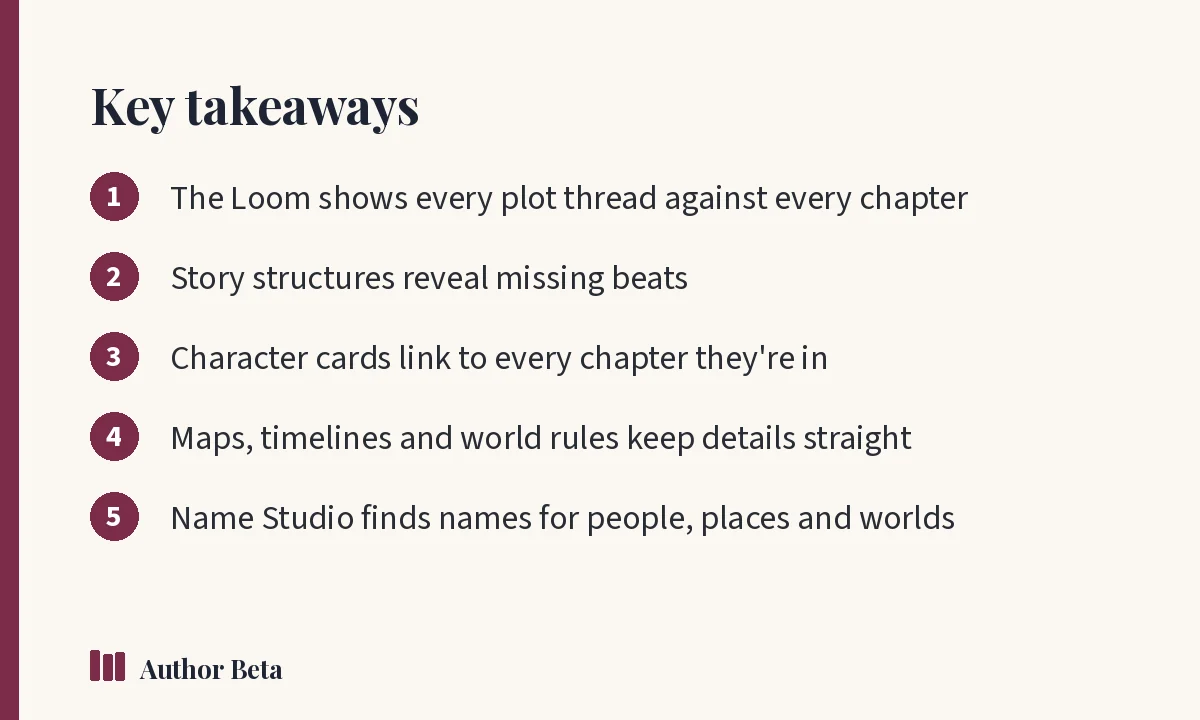
What it does for you. Every plot thread against every chapter, in a grid. You can see the subplot you dropped in chapter six, or the character who disappears for half the book.
How to use it. Add your threads (main plot, subplots, relationships, mysteries) and mark the chapters where each appears. Gaps jump out. See the Loom.
Why we built it. Dropped threads are one of the most common problems we see in first drafts, and they're hard to spot by rereading. A grid makes them obvious. It's especially useful during revision.
Story structures
What it does for you. Lay three-act structure, the hero's journey, romance beats or mystery beats over your chapters and see which beats are missing or out of place.
How to use it. Choose a structure, then match beats to chapters. See story structures.
Why we built it. Structures aren't rules, but they're useful lenses. Seeing your midpoint land at 80% of the book is a strong hint that the middle needs work.
Characters and the Web
What it does for you. Character cards, relationships and family trees, linked to every chapter each character appears in.
How to use it. Create a card for each character with their name, description, wants and secrets. Draw relationships in the Web. The desk shows which characters appear in each chapter. See characters.
Why we built it. Character details drift over a long book: eye colours change, ages don't add up. Linked cards keep the facts in one place.
Map Room and places
What it does for you. Your own maps with places pinned on them, and a card for every location.
How to use it. Upload or draw a map, pin locations, and give each place a card with its details. See Map Room.
Why we built it. Readers notice when a journey takes two days in one chapter and a week in another. Maps keep geography consistent.
World, Almanac and timeline
What it does for you. Your world's rules, its own calendar and a timeline of events.
How to use it. Record how magic, technology or society works, set up a custom calendar if your world needs one, and add events to the timeline. See world and timeline.
Why we built it. Fantasy and science fiction live or die by consistent rules, and every genre benefits from a clear timeline.
Series planner and story bible
What it does for you. Keep a whole series straight: books, arcs and everything you've decided.
How to use it. Create a series project and plan each book's arc inside the series arc. Your characters, places and rules become a living series bible. See series planning.
Why we built it. Series are how many indie authors build a career, and continuity across books is hard. Read how to plan a book series for the method behind the tool.
Name Studio
What it does for you. Names for people, places, worlds, gods, ships and alien species, from 32 real traditions or invented sounds.
How to use it. Open the Name Studio (no account needed), choose a tradition or style, and generate. Save favourites for your character cards. See Name Studio.
Why we built it. Naming characters can stall a whole writing session. Good names carry culture, era and personality.
Plotting tools for writers who don't outline
Discovery writers can use these tools after drafting, as a map of what they've written, rather than a plan. The Loom and structures are especially useful in revision. For general advice on planning and drafting, the Purdue Online Writing Lab offers free creative writing resources.
Frequently asked questions
Are the plotting tools free?
You can try every tool with the free Writing Desk (one project, one chapter). The whole desk is $36 a year, or included in Author Lite and Cliff Hanger.
Do I have to outline to use these tools?
No. Many writers use them during revision to see the shape of a draft they wrote freely.
Can I use the tools for a series?
Yes. Projects can be a single book or a series, with the series planner keeping books, arcs and decisions together.
Comments