


Rapid release is a launch strategy where an author publishes several books in a series close together, often weeks apart, rather than one a year. It's popular with indie authors because it gives readers the next book while they're still excited about the last one.
Here's how rapid release works, what it costs, and how to decide whether it's right for your series.
What is rapid release?
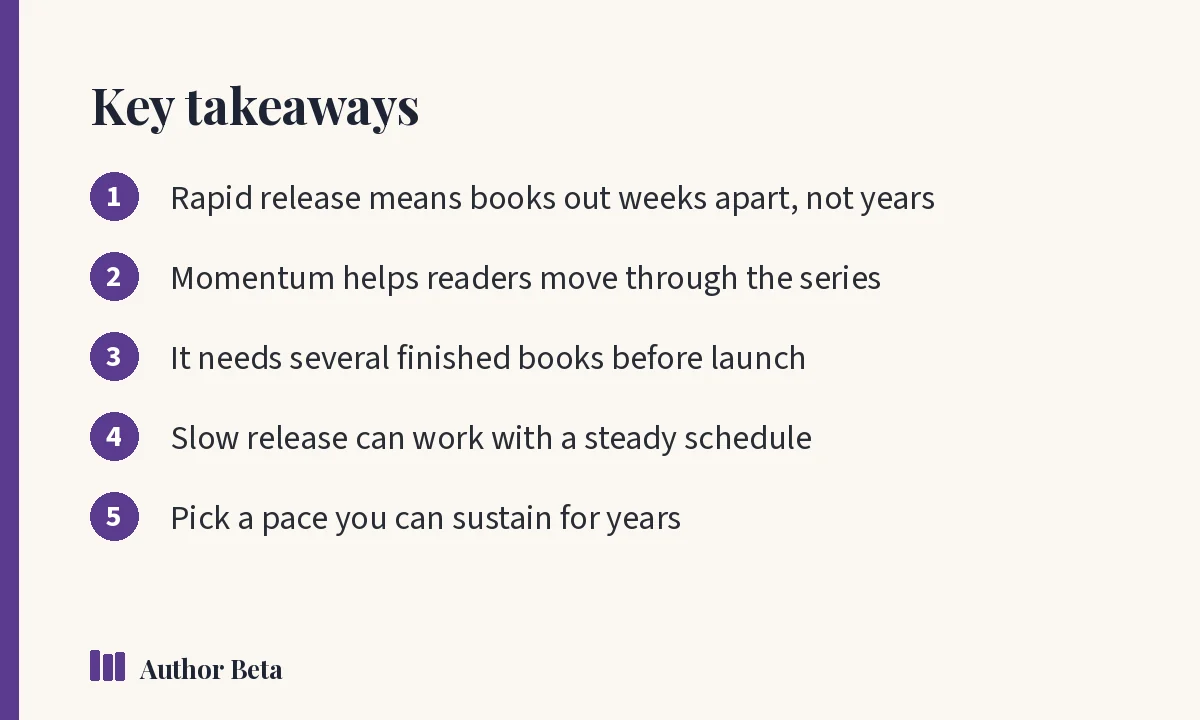
In a rapid release, an author finishes several books before publishing any, then releases them on a tight schedule, for example one book every two to six weeks. The idea is to build momentum: readers who finish book one can immediately buy book two, and online stores see steady activity around the author's name.
Benefits of rapid release
- Momentum: readers move through the series without losing interest.
- Visibility: frequent releases keep your name in front of readers and in "new release" lists.
- Marketing efficiency: advertising book one can lead to sales of every following book.
- Reader trust: readers are more willing to start a series they know is complete or arriving quickly.
Risks and costs
- Delay: you won't publish anything for months while you write the first books.
- Upfront costs: editing and covers for several books are paid before any income arrives.
- Burnout: writing and launching several books close together is demanding.
- No early feedback: if book one has a problem readers dislike, it may affect the books already written.
The last risk is a good reason to test book one with beta readers before you lock the series. See how to find beta readers.
Slow release can work too
Releasing a book every six to twelve months is still a viable path, especially if you:
- Keep a reliable, announced schedule
- Use a newsletter to keep readers engaged between books (see author newsletter)
- Write standalone-friendly books in an episodic series
Many successful authors release steadily rather than rapidly.
How to plan a rapid release
- Finish at least three books before releasing the first.
- Book editors and cover designers early, ideally with matching series covers.
- Set up pre-orders for later books so readers can commit.
- Plan your marketing around book one, since it's the entry point.
- Write the next books while the first ones release, if you want to keep going.
On Author Beta, campaign plans include launch and series schedules with every post and email drafted, and the marketing calendar puts each release date and deadline in one view.
Rapid release and store algorithms
Online stores tend to show books that are selling now, so frequent releases can help visibility. But algorithms change, and no schedule guarantees success. Focus on writing books readers want to finish, and treat release timing as a multiplier rather than a magic trick. For store-specific details, Amazon's KDP help pages explain pre-orders and release settings.
How to choose your schedule
Ask yourself:
- How many books can I realistically write per year?
- Can I afford to pay for several books before earning anything?
- Does my genre reward fast releases? Romance, thrillers and fantasy often do.
- Will I enjoy this pace for years?
The best schedule is one you can sustain. A steady pace you keep beats a burst you can't repeat.
A sample rapid release timeline
- Months 1–9: write books one to three; get covers designed as a matching set
- Month 10: beta readers and editing for book one
- Month 11: publish book one; set pre-orders for books two and three
- Month 12: publish book two
- Month 13: publish book three; begin promoting book one more widely
Adjust the gaps to your writing speed. The key is that every release date is one you can meet.
Ofte stilte spørsmål
How many books do I need for a rapid release?
Most authors finish at least three before launching. Some write five or more, depending on how long the series is.
How far apart should rapid release books be?
Common gaps range from two weeks to two months. Shorter gaps build stronger momentum but require more books finished in advance.
Does rapid release work for traditionally published authors?
It's mostly an indie strategy, because publishers control schedules. Some publishers do release series closer together, but authors rarely control the timing.



Kommentarer