

"Show, don't tell" is the most repeated piece of writing advice, and one of the most misunderstood. It doesn't mean you can never state a fact. It means that the moments that matter most should be experienced by the reader, not summarised for them.
This guide explains what show don't tell actually means, gives you techniques you can use in your next scene, and shows when telling is the better choice.
What show don't tell means
Telling gives the reader a conclusion: Mara was furious. Showing gives the reader evidence and lets them reach the conclusion: Mara set the cup down so hard the tea jumped onto the letter.
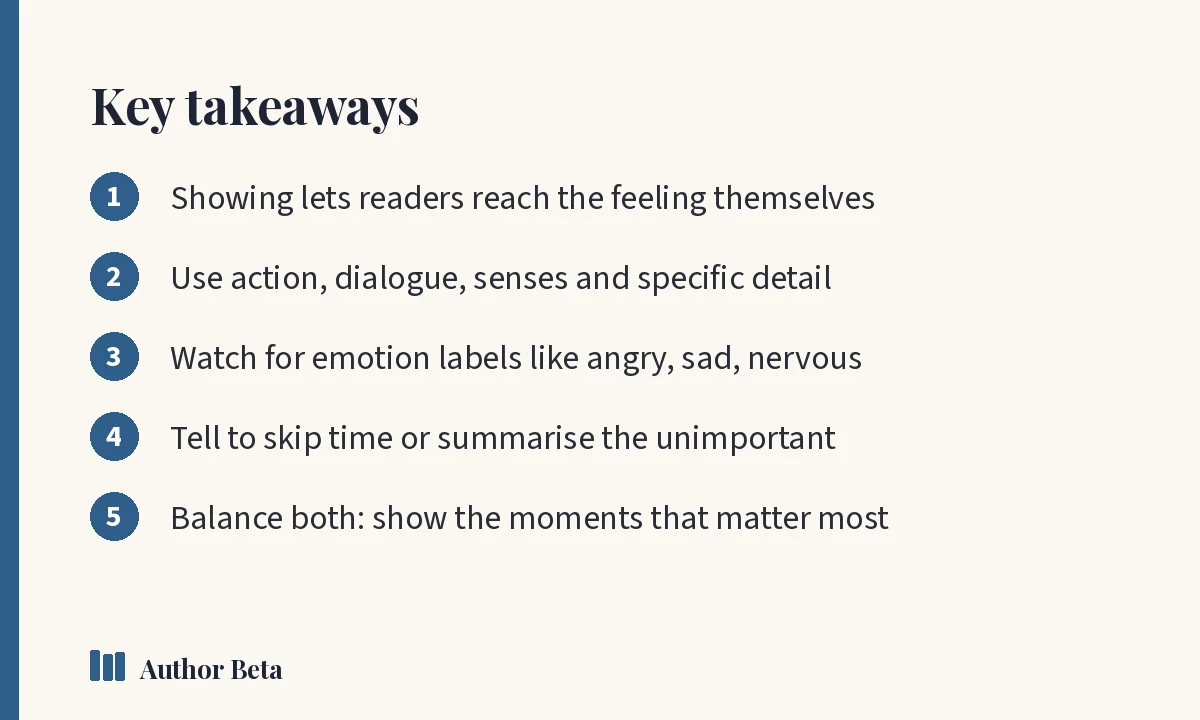
Readers enjoy working things out. When you show, they feel the emotion alongside the character instead of being informed about it. That's why showing builds immersion and tension.
Five techniques to show, don't tell
1. Use action and body language
Emotions change what people do. A nervous character fidgets with a ring, rereads a text three times, or laughs a beat too late. Pick one telling detail rather than listing every symptom.
2. Let dialogue carry the subtext
People rarely say exactly what they feel. "Fine. Take the car. I'll walk." tells us more about anger than She was angry. For more on this, see our guide on how to write dialogue.
3. Engage the senses
Sound, smell, texture and temperature put readers in the room. A kitchen that "smelled of burnt sugar and wet dog" is a place; "a messy kitchen" is a label.
4. Choose specific over general
"A car" is generic. "A dented red hatchback with one hubcap" tells us about money, care and character. Specific nouns and verbs do more work than adjectives.
5. Reveal character through choices
What a character does under pressure shows who they are. Rather than writing He was generous, let him quietly pay for the stranger's groceries and change the subject when she thanks him.
Before and after examples
Telling: Tom was scared of the dark house.
Showing: Tom kept one hand on the wall as he climbed. Every stair creaked louder than the last, and he found he'd stopped breathing.
Telling: Ella was a talented baker.
Showing: By eight the queue was out the door, and the cinnamon buns were gone by nine.
When telling is the better choice
Showing everything would make your book bloated and slow. Telling is the right tool when you need to:
- Skip time: Three weeks passed without a letter.
- Summarise routine events the reader doesn't need to live through
- Keep pace during transitions between important scenes
- Deliver small facts quickly, such as a character's job or the weather
The skill is choosing which moments deserve full showing: turning points, emotional peaks and first impressions. Summarise the rest.
How to find telling in your own draft
Search your manuscript for emotion labels such as angry, sad, happy, nervous, afraid, excited and for phrases like she felt, he realised and she noticed. Not every hit is a problem, but each one is worth a second look.
On Author Beta, the Writing Desk's Red Pencil checks a whole book for crutch words and repeated phrases, which makes this kind of search fast. Beta readers help too: when several readers say a scene felt flat, it's often a sign it's being told rather than shown.
Show don't tell in different genres
The balance between showing and telling shifts by genre:
- Thrillers show physical danger in sharp detail but summarise travel and logistics quickly to keep the pace high.
- Romance lingers on small physical and emotional moments: a glance, a hesitation, a hand that doesn't quite let go.
- Fantasy and science fiction must explain new worlds, so they often tell small facts briefly and show the rules of the world through characters using them.
- Literary fiction may tell more openly, using a strong narrative voice to comment on events.
Reading a few recent books in your genre with this lens is one of the fastest ways to calibrate your own balance.
A quick exercise
Take one paragraph from your draft that names an emotion directly. Rewrite it three ways: once with only action, once with only dialogue, and once with only sensory detail. Then combine the strongest lines. This takes ten minutes and usually produces a better paragraph than any of the three alone.
For a deeper look at the craft vocabulary behind this advice, the Purdue Online Writing Lab has free guides on creative writing techniques.
Questions fréquentes
Is show don't tell a rule?
It's a guideline, not a law. Every good novel mixes both. Show the moments that carry emotion or change the story, and tell when you need to move quickly.
Does show don't tell apply to nonfiction?
Yes, in a lighter form. Memoir, narrative nonfiction and even business books become more persuasive with concrete examples and scenes instead of abstract claims.
Can I overdo showing?
Yes. Long strings of physical reactions and sensory details can feel melodramatic or slow. If a moment isn't important, a single line of telling is kinder to the reader.
Commentaires