

Name Studio
Names for people, places, realms, inns, orders, species, artifacts, ships and worlds: real traditions, invented sounds or your own, with a look-alike warning. No AI.
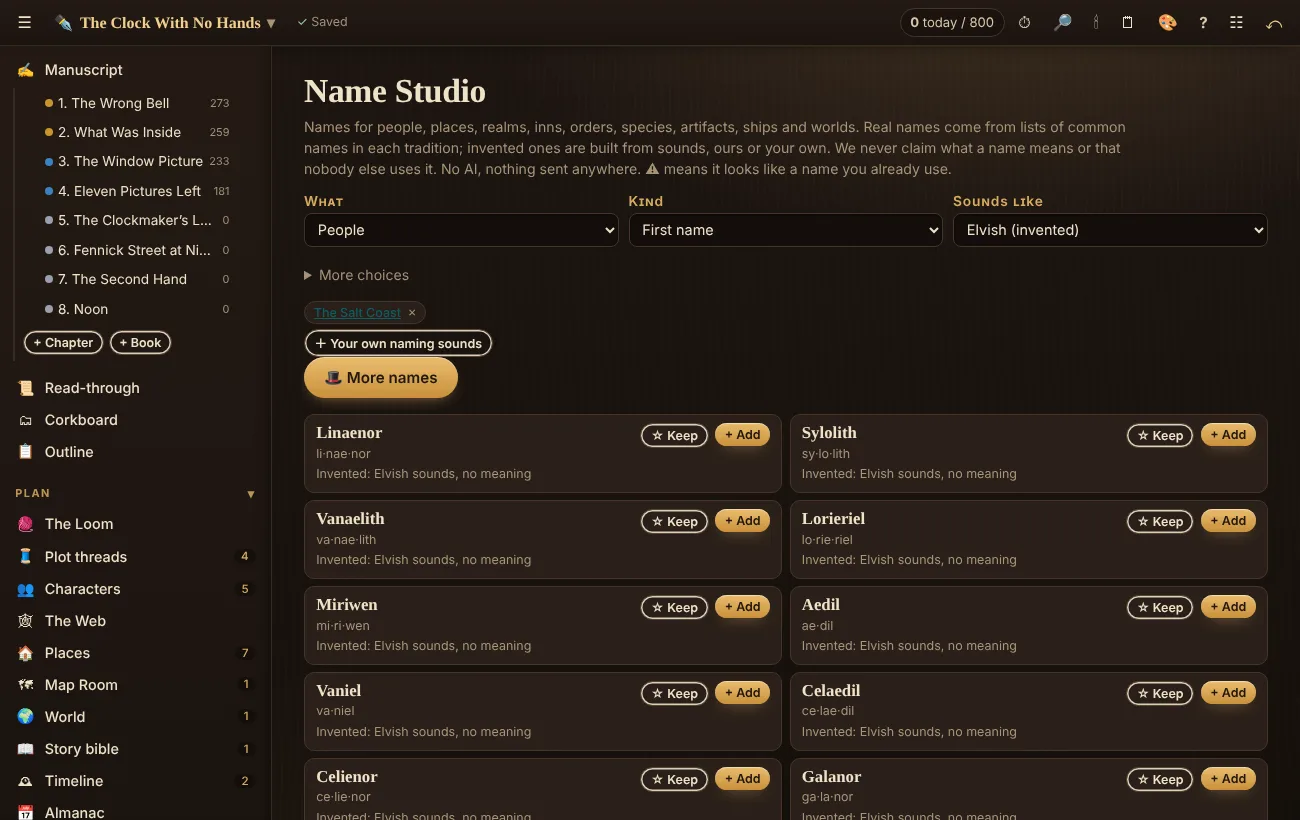
Name Studio is in the Writing Desk under Name Studio, and free for anyone at authorbeta.com/names.php (no account needed). No AI, and nothing is sent anywhere: names are made in your browser.
- Choose What: people, places, groups, peoples and creatures, or things. Then the Kind: a full name, first name, family name or nickname; town, city, kingdom, river or mountain, inn; an order, guild or house, a company; a species or creature; a weapon or artifact, a ship, a starship, a planet.
- Choose Sounds like: real names from 32 traditions, one of our invented sound sets (elvish, dwarvish, fae, draconic, sci-fi, alien and more), or your own. The full list is below.
- Under More choices: usually male or female (real names), starts with, ends with, letters never to use, how many syllables, easy to read only, and whether apostrophes are allowed.
- Press More names until one fits. ☆ Keep puts it on your list; + Add makes a character, place or world card straight away (an inn becomes a place, an order becomes a world entry, and so on).
Your own naming sounds
Give each culture in your world its own sound: press + Your own naming sounds, name it (the Salt Coast, the Old Tongue), and list its starting sounds, vowels and endings, or start from one of ours and change it. You see sample names as you type. Your sound sets are saved with the project and appear under Sounds like.
What each name tells you
- Where it came from: “Common in Nordic tradition”, or “Invented: Elvish sounds, no meaning”. We never claim what a name means, where it comes from, or that nobody else uses it.
- A rough sounding-out guide for invented names (ga·le·riel). It’s a hint, not a dictionary pronunciation.
- ⚠ when it looks like a name already in your project or on your kept list. Readers mix up names that look alike (Kirella and Kirela), so pick another.
- A note when readers may stumble: four consonants in a row, a very long word, several apostrophes.
Your kept list can be copied, or downloaded as CSV or plain text.
What it can name
- People from 32 real traditions: English; American, plus the American South, Northeast, Midwest and West; Irish and Scottish; Welsh; Anglo-Saxon; Swedish, Norwegian, Danish, Icelandic and Finnish; Viking and Old Norse; German, French, Spanish and Latin American, Italian; Ancient Greek and Roman; Slavic, Arabic, Persian, Hebrew, Indian, Chinese, Korean, Japanese, Hawaiian and West African.
- Icelandic and Viking names use patronymics: the father’s name plus -son or -dóttir, matched to the person. Viking nicknames give bynames such as “Harald Ironside”. Chinese and Korean names put the family name first.
- Invented sounds: elvish, dwarvish, harsh, gentle, Norse-flavoured, fae, dragon tongue, celestial, infernal, desert empire, sea folk, science fiction, cyberpunk, and three alien families (clicks and stops, flowing vowels, insect hive). Or make your own culture.
- Places: towns, cities, countries, kingdoms, continents, worlds, rivers and mountains, seas, inns. Towns from a real tradition sound like it (Swedish “Västertorp”, Western “Coyote Falls”, Southern “Possum Bend”).
- Groups, beings and things: orders, clans, faiths, armies and fleets, companies; species, alien species, gods, creatures; weapons, ships, starships, space stations, planets and star sectors.
Real-tradition lists are common names that feel at home there, not rules, and regional American lists lean on familiar choices. Check names for real people before you use them.
Related
- Characters · A card for everyone in your story: role, other names, traits, relationships and where they last appeared.
- Places · Houses, towns, ships and planets: where your story goes, with details and who is connected to each.
- World · Cultures, factions, magic, technology, creatures, languages and history: the rules your world runs on.
Still stuck, or something here is wrong? Tell us and we’ll fix it.